
Topic overview
In brief
- Researchers found a rare ice age toad fossil in the La Brea Tar Pits, California.
- The fossil belongs to a new species of spadefoot toad, identified by J. Alberto Cruz.
- This discovery provides valuable insights into ancient climate conditions and biodiversity.
Summary
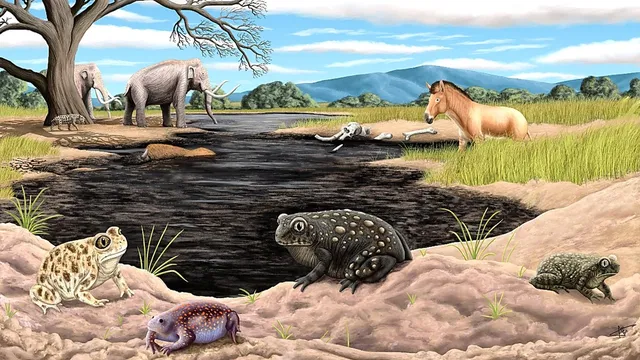
In the La Brea Tar Pits located in Los Angeles, California, researchers uncovered a rare ice age toad fossil, marking only the second amphibian fossil from this period found in North America. The fossil, estimated to be around 45,000 years old, was discovered among other ancient remains, including mammoths and various plants. J. Alberto Cruz, a paleoecologist, identified the toad's hip bone as belonging to a previously unknown species of spadefoot toad, differing significantly from modern counterparts. This discovery is significant as it provides insights into the climate conditions of the time, indicating that the area was once a cold, wet forest suitable for amphibians.
The fossilization of amphibians is rare due to their delicate bones, making this find particularly valuable for understanding past ecosystems. The presence of such fossils can reveal information about ancient climates that larger fossils cannot, as smaller creatures like toads are more sensitive to environmental changes. The discovery of this new species not only adds to the biodiversity known from the ice age but also highlights the importance of the La Brea Tar Pits as a site for paleontological research.