
Topic overview
In brief
- On August 5, 2026, a piece of SpaceX rocket debris crashed into the Moon.
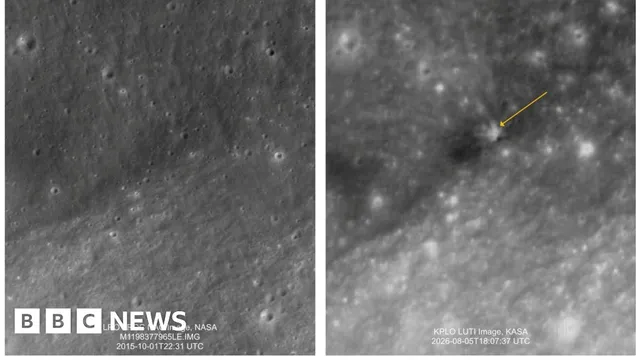
- The impact was captured by South Korea's lunar orbiter, Danubri, which provided images before and after the event.
- Experts are raising concerns about the increasing problem of space debris in Earth's orbit.
Summary
On August 5, 2026, South Korea's space agency, the Korean AeroSpace Administration (KASA), released images of the Moon captured by its lunar orbiter, Danubri, following the impact of a piece of SpaceX rocket debris. The debris, part of a Falcon 9 rocket, struck the Moon's surface at approximately 06:35 GMT. This incident occurred after the rocket had been in orbit since January 2025, when it launched from Florida carrying two lunar landers. The upper stage of the Falcon 9, which is about the size of a five-storey building and weighs around 4,000 kg, was left drifting in a long, looping orbit that eventually led it to collide with the Moon. Scientists had predicted that the rocket part would hit the Moon at a speed of about 5,400 mph (8,700 km/h). The impact created a brief flash that was difficult for amateur astronomers to observe, but larger observatories, including KASA, are analyzing the data collected from the event. While the crash did not pose any danger to Earth, astronomer Matt Bothwell from the University of Cambridge expressed concerns about the increasing amount of space debris. He noted that as more objects are launched into space each year, the risk of collisions and the challenges of navigating through Earth's orbit could become significant issues in the coming decades. The Falcon 9 rocket that caused the impact was part of a mission that aimed to send two lunar landers on a trajectory toward the Moon, and the spent upper stage had been gradually nudged by gravitational forces and solar radiation, ultimately leading to its collision with the lunar surface. This incident highlights the growing problem of space debris and the need for careful monitoring and management of objects in orbit.