
Topic overview
Briefly
- A wildfire in Belgium's High Fens nature reserve burned 30 square kilometers.
- About 600 residents in Liège province were evacuated due to shifting winds and smoke.
- An elderly couple died and ten people were injured in a fire on the Greek island of Salamis.
What happened
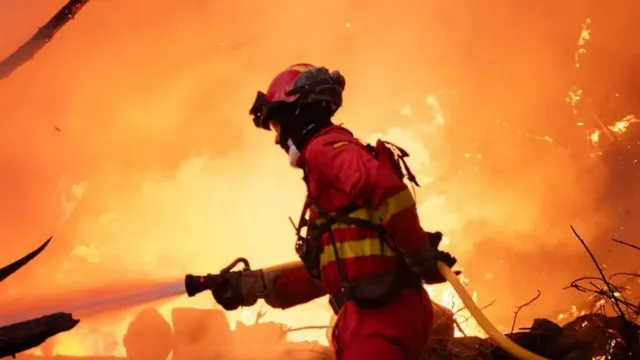
In late July 2026, a series of severe wildfires broke out across multiple European nations, with Belgium and Greece facing particularly devastating blazes. In eastern Belgium, a massive wildfire ignited in the High Fens nature reserve, a unique landscape of heathland and peat bogs near the German border. The fire consumed approximately 30 square kilometers, making it one of the worst wildfires in the country's recent history. The difficult terrain, characterized by very dry soil, complicated firefighting efforts. Nicolas Yernaux, a spokesperson for the Public Service of Wallonia, noted that conditions were significantly worse than in previous incidents due to the parched ground. René Dahmen, chief engineer at the Department of Nature and Forest, reported that the fire continued to spread on Sunday, with a kilometer-long flank advancing slowly toward a municipal forest. The proximity to Germany raised alarms, with local authorities warning that the fire was just 1.5 kilometers from the border. The emergency prompted the evacuation of about 600 residents from the municipalities of Waimes and Bütgenbach in Liège province, while tourists were also advised to leave the area. A gymnasium was opened to shelter evacuees. A substantial response force of 260 firefighters, including 15 ground teams, 10 aircraft, and eight helicopters, was deployed to combat the flames.
The European Union activated its Civil Protection Mechanism to coordinate international assistance. Sweden dispatched two water-bombing aircraft, while the Netherlands and the Czech Republic contributed helicopters. Hadja Lahbib, the Commissioner for Crisis Management, described the summer of 2026 as "an intense fire season" for the EU and highlighted the demonstration of "unwavering European solidarity." However, the strain on resources was evident as the mechanism was simultaneously activated for Spain, where French firefighting teams were sent to help control a fire in the Aragon region. The EU's Copernicus satellite system provided mapping support for operations in Spain, Greece, France, Germany, Albania, and Serbia, indicating the widespread nature of the crisis.
In Greece, the situation turned deadly on the island of Salamis. A wildfire there resulted in the deaths of an elderly couple and left ten people injured, according to Greek Minister for Health Adonis Georgiadis. Around 600 people were evacuated from the island due to the advancing flames. The fatalities on Salamis marked the most serious human toll of the 2026 European fire season up to that point. European Commission President Ursula von der Leyen stated that the EU was on high alert and that its Emergency Centre was closely monitoring fires across the continent. She also warned that the pressure was mounting beyond the EU's borders, with Albania, Bosnia and Herzegovina, Montenegro, and Serbia also facing significant wildfire threats.
The wildfires occurred against a backdrop of extreme heat and drought gripping the continent. The United Kingdom also experienced fire emergencies, with 14 wildfires burning in South Wales, supported by military personnel, and more than a dozen homes gutted in the West Midlands of central England. This followed the hottest day of the year recorded on a Thursday, when temperatures reached 38.1°C. The fires in Belgium's High Fens were particularly challenging due to the nature reserve's mix of heathland and peat bogs, which allowed the fire to burn deep into the dry soil. The incident was the third major wildfire in the vast pine forests of southwestern France that summer, following two others in late July, one of which burned about 420 square kilometers in the Gironde department and forced the evacuation of approximately 220,000 people as it spread toward the Atlantic coast and the Bordeaux area. The convergence of these disasters across multiple countries underscored the severity of the 2026 fire season and the increasing pressure on national and EU-level emergency response systems.

Comprehensive report
Full story,
in detail.
Trace the developments that led here, see how the story evolved, and understand the forces and wider context surrounding it.