
Topic overview
In brief
- Andromeda galaxy has been slowing its production of new stars for the past 500 million years.
- The decline in star formation is linked to a previous merger with the M32 galaxy.
- This research provides insights into the evolution of large spiral galaxies as they approach potential collisions.
Summary
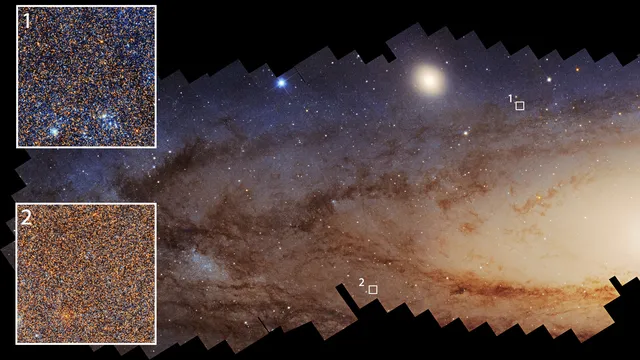
The Andromeda galaxy, the nearest large spiral galaxy to Earth, has been undergoing significant changes in its star formation activity. Recent research, published in The Astrophysical Journal, indicates that Andromeda has been gradually decreasing its rate of new star production over the last 500 million years. This decline is particularly notable as Andromeda approaches a potential collision with the Milky Way, which is expected to occur in about 5 billion years. The study utilized data from the Hubble Space Telescope, which mapped approximately two-thirds of Andromeda's disk and included around 200 million stars.
Historically, Andromeda experienced a dramatic surge in star formation approximately 2 billion years ago, believed to be triggered by a merger with the compact elliptical galaxy M32. This merger is thought to have contributed to the formation of about one-fifth of all the stars currently in Andromeda. The new findings suggest that the galaxy is not abruptly running out of material for star formation but is instead naturally winding down from a previously active period.