
Topic overview
Briefly
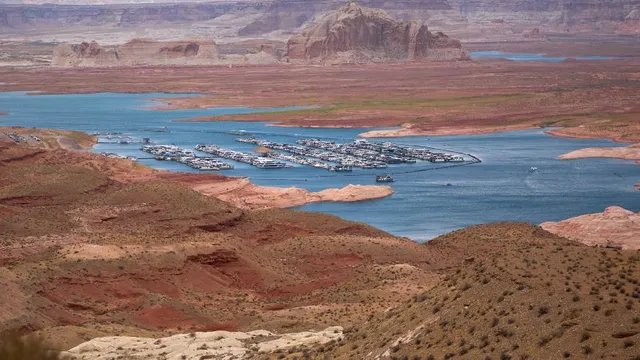
- Lake Powell dropped to 3519.91 feet on Saturday, breaking the previous record low of 3,519.92 feet.
- The reservoir is approaching the 'minimum power pool' level of 3,490 feet, below which turbines can’
- Experts warn that even record snowpack this winter will not be enough to end the crisis.
What happened
Lake Powell, the second-largest reservoir in the United States, has reached its lowest level on record, dropping to 3519.91 feet on Saturday, according to data from the US Bureau of Reclamation. This surpasses the previous record low of 3,519.92 feet set in April 2023. The reservoir, which spans parts of Arizona and Utah, was formed by the Glen Canyon Dam, constructed in the 1950s. It serves as a critical water supply and hydroelectric source for millions of people across the West, including states such as Colorado, Utah, Wyoming, New Mexico, Arizona, Nevada, and Nebraska. The decline is part of a broader crisis affecting the Colorado River, which has been shrinking for over two decades due to a combination of climate change-fueled drought, rising temperatures, and heavy water use. The river provides water to roughly 40 million people and irrigates more than 5 million acres of farmland across seven states. The record low at Lake Powell comes just nine days after Lake Mead, the largest reservoir in the US, dropped to its lowest level since it was first filled in the 1930s. These unprecedented declines highlight the perilous state of the river system, which is essential for agriculture, cities, and hydropower generation. The reservoir is now approaching the 'minimum power pool' level of 3,490 feet, below which water levels would be too low to spin the turbines at the Glen Canyon Dam and generate electricity. Brad Udall, a senior water and climate research scientist at Colorado State University, warned that this 'scary threshold' could be reached this year unless extraordinary measures are taken. If the water level falls below this point, water would no longer be able to flow downstream from the dam, which would have severe consequences for water supply and power generation. The Bureau of Reclamation and the Department of the Interior have stated they are committed to reducing the risk of both Lake Powell and Lake Mead falling below critical elevations to protect infrastructure and meet the water and hydropower needs of the basin. Experts do not currently believe there is an immediate risk of taps running dry, as many water managers have taken steps to prepare. Cities like Phoenix and Tucson are aware they are first in line for cuts and have developed backup supplies to meet demand, according to Sarah Porter, director of the Kyl Center for Water Policy at Arizona State University. The record low at Lake Powell comes as the seven states that share the Colorado River's water await decisions on mandatory cuts. There is some hope that the El Niño climate pattern, which tends to bring more rain and snow to the Southwest, could provide relief. However, experts emphasize that one wet winter will not be enough to resolve the crisis. Porter noted that even record snowpack this winter would not be sufficient to pull the river out of the danger zone. The situation underscores the urgent need for long-term water management strategies and cooperation among the states to address the ongoing drought and ensure sustainable water supplies for the future.

Comprehensive report
Full story,
in detail.
Trace the developments that led here, see how the story evolved, and understand the forces and wider context surrounding it.