
Topic overview
In brief
- The Ministry of Justice has reported costs exceeding £85,000 for the removal of a Banksy mural.
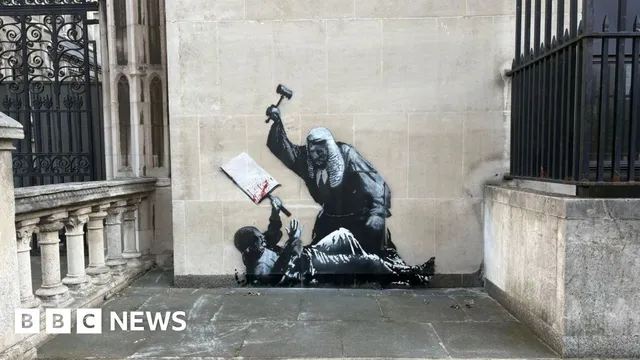
- The mural, depicting a judge striking a protester, was painted on September 8, 2025.
- The ongoing financial burden raises questions about the nature of Banksy's work and its impact on public resources.
Summary
In the United Kingdom, a mural created by the street artist Banksy on the Royal Courts of Justice has sparked significant financial implications for taxpayers. The mural, which depicts a judge in a wig striking a protester with a gavel, was painted on September 8, 2025. Since its appearance, the Ministry of Justice has reported expenditures exceeding £85,000 for removal efforts and security measures. This includes £50,000 spent on attempts to remove the paint from the Grade II-listed building's wall. The ongoing costs have raised questions about the nature of Banksy's work, with debates intensifying over whether it constitutes vandalism or valuable public art. The Royal Courts of Justice, being a listed building, requires preservation of its original character, which complicates the removal process. Initial attempts to scrub off the mural were unsuccessful, leading to the use of advanced laser technology for removal. If these efforts fail, the affected stonework may need to be replaced entirely. This incident is not isolated; previous works by Banksy have also incurred costs for public bodies. For instance, a statue he installed in Westminster led to nearly £60,000 in expenses for safety barriers and security. The Westminster City Council, which owns the land where the statue was placed, stated that it had no prior knowledge of the installation and is currently reviewing options regarding the statue's future. Banksy's influence continues to be felt more than three decades after he first gained recognition in Bristol, where his surviving murals remain popular tourist attractions. The financial burden of his works on public entities raises concerns about the responsibilities of artists and the implications of street art in urban environments.