
Topic overview
Briefly
- Two weeks ago, over 72,000 migrants rushed toward Ceuta, leaving at least 90 dead on both sides of t
- Moroccan authorities arrested 294 sub-Saharan migrants and 61 alleged facilitators on Saturday durin
- Spanish interior minister stated irregular migrants will not be allowed to stay in Ceuta or reach ma
What happened
Moroccan security forces intensified their operations along the border with the Spanish exclave of Ceuta, resulting in the arrest of 294 migrants from sub-Saharan Africa on Saturday. The state broadcaster Medi 1 TV reported that these individuals were detained while attempting to enter Ceuta by both land and sea routes. In a parallel operation, authorities also apprehended 61 Moroccan nationals who were allegedly facilitating these irregular migration attempts. This enforcement action represents a significant escalation in border security measures following a massive migration crisis that unfolded two weeks prior.
The recent arrests are a direct response to the extraordinary events of late July and early August 2026, when more than 72,000 would-be migrants rushed toward Ceuta in one of the deadliest migration crises to affect the region. That mass movement was driven by a combination of poverty and widespread misinformation circulating on social media platforms, which encouraged people to attempt the crossing. Official figures indicate that at least 90 people lost their lives on both sides of the border during that crisis, though human rights organizations have suggested the actual death toll may be considerably higher. The scale of that event overwhelmed local resources and prompted both Moroccan and Spanish authorities to significantly reinforce their security presence along the frontier.
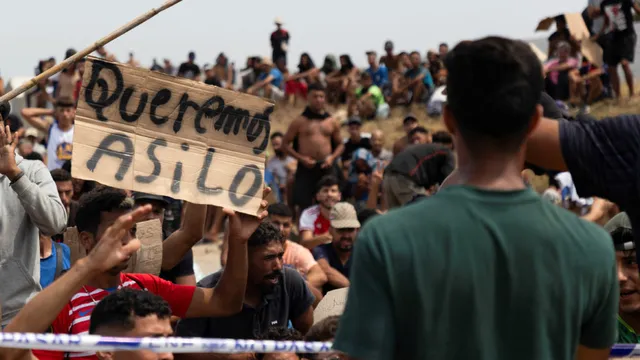
In the aftermath of the mass crossing attempt, an estimated 5,000 to 8,000 migrants remained within Ceuta, placing enormous strain on the city's infrastructure and resources. Many of these individuals have been living in precarious conditions on Trampolin beach and in outlying areas of the city, waiting for opportunities to continue their journey toward continental Europe. On Sunday, hundreds of these stranded migrants staged a protest on a popular urban beach, brandishing Spanish flags and displaying banners with messages such as "We don't want to go back to Morocco" and "We are also human." The demonstrators chanted slogans expressing their exhaustion and demanding solutions from Spanish authorities, while also complaining about police restrictions preventing them from accessing the city center.
Spanish Interior Minister Fernando Grande-Marlaska addressed the situation earlier in the week, making clear that migrants who had entered Ceuta irregularly would not be permitted to remain in the exclave, travel to mainland Spain, or obtain legal status, with exceptions only in rare cases involving extreme vulnerability. A senior Moroccan diplomat disclosed that more than 20,000 Moroccan security personnel are deployed along the Ceuta border on a daily basis, at an annual cost of hundreds of millions of dollars. The broader context involves thousands of migrants from across Africa and beyond who travel to Morocco each year, fleeing conflict, poverty, and instability, seeking routes into Europe through Ceuta or Melilla, another Spanish exclave on Morocco's northern coast.

Comprehensive report
Full story,
in detail.
Trace the developments that led here, see how the story evolved, and understand the forces and wider context surrounding it.