
Topic overview
Briefly
- Astronomers have observed tiny crimson smudges in deep images from the James Webb Space Telescope, known as little red dots.
- Recent studies suggest these dots may not have vanished but instead changed appearance as the universe aged.
- The findings indicate that many little red dots could be ordinary galaxies at vast distances, challenging previous assumptions.
What happened
In recent months, astronomers have been intrigued by the discovery of tiny crimson-colored smudges in the deep images captured by NASA's James Webb Space Telescope (JWST). These enigmatic objects, referred to as 'little red dots' (LRDs), appeared prominently in images of the early universe, specifically around 600 million years after the Big Bang, before seemingly vanishing less than a billion years later. Their compact nature and bright glow in infrared light have made them difficult to classify, leading to speculation about their true identity.
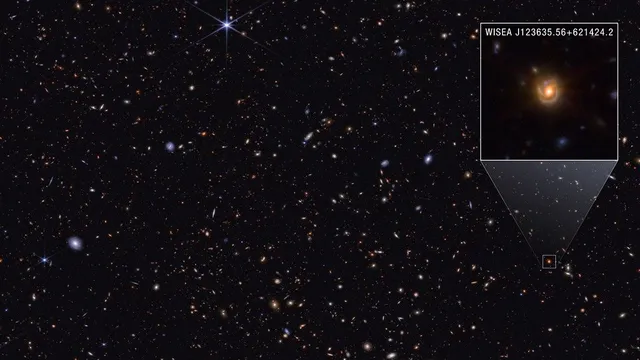
To investigate these mysterious LRDs, researchers utilized JWST alongside data from the Hubble Space Telescope and NASA's Chandra X-ray Observatory. They focused on a relatively nearby galaxy known as WISEA J123635.56+621424.2, nicknamed the Saguaro due to its resemblance to a cactus. This galaxy existed approximately 3.3 billion years after the Big Bang, a time long after LRDs were thought to have faded from view. The Saguaro's core exhibited characteristics similar to LRDs, including weak X-ray emissions, prompting researchers to explore its appearance at greater distances.
Using computer models, the team simulated how the Saguaro would appear if it were located in the early universe. As they adjusted the distance, the galaxy's spiral arms gradually faded, leaving behind a small glowing red point that closely resembled the LRDs observed in JWST's deep-field images. This finding suggests that many of the LRDs may not represent a new class of cosmic objects but rather ordinary galaxies whose outer structures become invisible at vast distances, leaving only their bright, active centers visible.
The implications of this research are significant, as they indicate that LRDs may represent a transient phase in the evolution of supermassive black holes during the universe's formative years. The scientific community is now focused on identifying more nearby galaxies like the Saguaro to further understand the relationship between galaxies and their central black holes throughout cosmic history.

Comprehensive report
Full story,
in detail.
Trace the developments that led here, see how the story evolved, and understand the forces and wider context surrounding it.