
Topic overview
Briefly
- Ukraine struck the Progress Rocket and Space Center in Samara with Flamingo missiles, causing a fire
- The facility produces Soyuz rockets and Rassvet satellites, Russia's Starlink analogue
- Zelensky said the strike is part of 'long-range sanctions' to reduce Russia's war potential
What happened
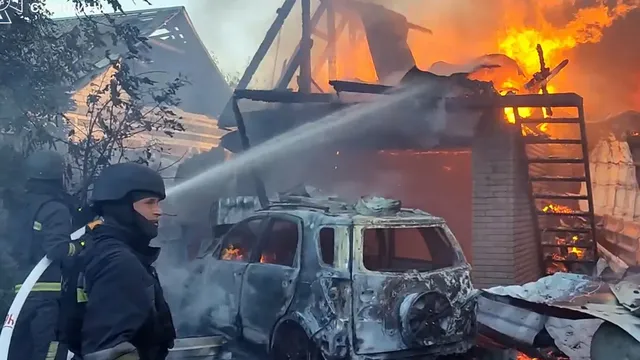
On August 15, 2026, Ukraine conducted a large-scale long-range strike against multiple targets inside Russia, marking a significant escalation in its campaign to degrade Russian military and industrial capabilities. The most prominent target was the Progress Rocket and Space Center in Samara, a key facility of the Russian state space agency Roscosmos. Ukrainian President Volodymyr Zelensky confirmed that the strike used domestically produced FP-5 Flamingo cruise missiles, which traveled approximately 900 kilometers from the Ukrainian border. The Progress center is responsible for manufacturing Soyuz launch vehicles, which are used to deploy Russian military, reconnaissance, and communications satellites, including the Rassvet constellation, Russia's answer to Starlink. The facility also produces Earth observation satellites used for reconnaissance. The attack caused a fire at the complex, with thick smoke visible in videos shared on social media. Samara's mayor, Ivan Noskov, acknowledged that the city's industrial infrastructure sustained localized damage and reported casualties, though he did not specify the extent. The strike was part of a broader wave of attacks that also targeted the Savasleyka military airfield in the Nizhny Novgorod region, home to MiG-31K aircraft that launch Kinzhal hypersonic missiles against Ukraine, and an oil facility in Ust-Luga, a major port on the Baltic Sea. Zelensky described these strikes as part of Ukraine's "long-range sanctions" against Russia, aimed at reducing Russia's war potential and pushing the Kremlin toward negotiations. The attacks disrupted air traffic, with temporary restrictions at several Russian airports. Russia's Defense Ministry claimed to have intercepted 598 Ukrainian drones overnight across 19 regions, as well as in Crimea and the Black and Azov Seas. In Moscow, 15 drones were shot down, and falling debris injured a woman and a nine-year-old boy. The strikes on Samara and other targets came amid a series of recent Ukrainian attacks on Russian oil refineries and military installations, including a drone strike on the Orsknefteorgsintez refinery in the Orenburg region on August 13, which forced a complete shutdown that could last up to six months due to sanctions limiting replacement equipment. Another strike targeted the Gazprom Neftekhim Salavat refinery in Bashkortostan. In response, Russia launched 152 attack drones at Ukraine overnight, with Ukrainian forces claiming to have shot down or neutralized 124. The Russian attacks killed a three-month-old child and injured 11 people in Marhanets, Dnipropetrovsk region, and damaged infrastructure in Odesa and Poltava regions. The UN Human Rights Monitoring Mission reported that July 2026 was the deadliest month for civilians in Ukraine since May 2022, with 437 killed and 2,610 injured. The conflict has also intensified in the Black Sea, with both sides targeting ports and vessels. Russia has rejected calls for a pause in Black Sea attacks and ruled out reviving the Black Sea Grain Initiative. Zelensky also signed a decree imposing sanctions on 13 vessels, 11 Russian citizens, and 28 companies accused of exporting grain from occupied territories. The strikes on the Progress center and other targets demonstrate Ukraine's growing capability to strike deep into Russian territory using domestically developed weapons, a development that could have significant implications for the course of the war.

Comprehensive report
Full story,
in detail.
Trace the developments that led here, see how the story evolved, and understand the forces and wider context surrounding it.