
Topic overview
Briefly
- Reagan initially opposed arms control and filled his team with hardliners.
- Secretary of State George Shultz persistently pushed for negotiations with Gorbachev.
- Three summits overcame a breakdown over the 'star wars' missile defense shield.
What happened
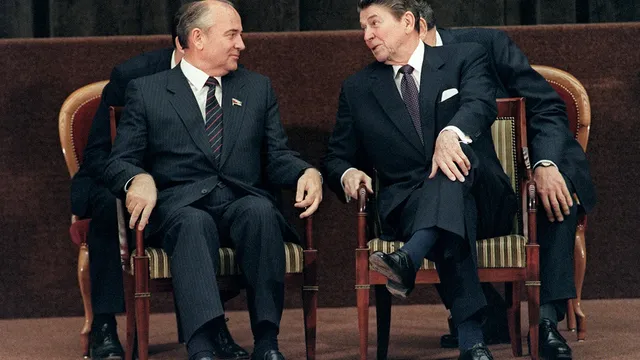
The article contrasts the chaotic and often contradictory foreign policy approach of the Trump administration with the methodical, expert-driven diplomacy of President Ronald Reagan, which successfully concluded a major arms control agreement with the Soviet Union. The piece uses the backdrop of a new movie, "The Brink of War," to revisit this historical period. The central narrative focuses on how Reagan, a president who built his early political reputation by staunchly opposing détente and arms control agreements, ultimately became the architect of the most significant such treaty since 1972. This transformation was not immediate but occurred through a deliberate and persistent process of high-stakes negotiation with Soviet leader Mikhail Gorbachev.
Reagan's initial foreign policy team was filled with hardliners who shared his opposition to the Nixon-era policy of easing relations with the Soviet Union. The pivotal change began with the appointment of George Shultz as Secretary of State in 1982. Shultz, despite his own neoconservative credentials as a member of the Committee on the Present Danger, became a crucial advocate for prioritizing arms-control negotiations. He consistently lobbied Reagan to pursue this path, even when facing significant resistance from other hardline voices within the administration. Shultz's leadership was instrumental, but it was complemented by the experienced team of foreign policy experts he assembled at the State Department, a stark contrast to a department depleted of its expertise.
The path to the treaty was arduous and required a series of three critical summits between Reagan and Gorbachev. The first meeting took place in Geneva in 1985, followed by a second in Reykjavik, Iceland, in 1986, and a final, successful meeting in Washington in 1987. The primary obstacle was Reagan's commitment to the Strategic Defense Initiative (SDI), a proposed missile defense shield that was widely derided as "star wars" and considered technologically unfeasible by most scientific experts. The Reykjavik summit famously broke down over this very issue. However, a key moment came when Shultz helped the president understand that despite the failure to reach a final deal in Iceland, the negotiations had actually achieved significant, previously unrecognized progress. This insight was crucial for maintaining momentum.
The ultimate success of the negotiations, which resulted in the Intermediate-Range Nuclear Forces (INF) Treaty, rested on a combination of factors. Gorbachev's own skills and commitment to reform through his programs of perestroika and glasnost were essential, as his policies opened the door to serious dialogue. Within the United States, the outcome depended heavily on the steady leadership of George Shultz and his expert team, as well as on Reagan's personal willingness to reconsider his earlier, deeply held positions. Crucially, it also required Reagan's determination to persevere through repeated setbacks and breakdowns in talks, demonstrating a flexibility and commitment to diplomacy that ultimately redefined his legacy and reshaped the geopolitical landscape.

Comprehensive report
Full story,
in detail.
Trace the developments that led here, see how the story evolved, and understand the forces and wider context surrounding it.