
Topic overview
Briefly
- Donald Trump announced a shift in U.S. strategy towards Iran, focusing on economic pressure instead of military strikes.
- He highlighted Iran's financial struggles, including high inflation and military payment issues, exacerbated by a U.S. naval blockade.
- This approach aims to facilitate negotiations while monitoring the economic toll on Iran, suggesting a strategic and cautious path forward.
What happened
In recent statements, United States President Donald Trump indicated a strategic shift in the U.S. approach towards Iran, emphasizing economic pressure over military action. This change comes after months of escalating tensions and conflict in the region. Trump noted that Iran is currently facing significant financial difficulties, including high inflation and challenges in compensating its military personnel. He attributed these economic strains to a U.S. naval blockade that has been in effect since April, which he believes has intensified the pressure on Iran's economy. Furthermore, Trump mentioned that falling oil prices, now hovering just above $75 a barrel, have alleviated some economic burdens on American consumers, suggesting a more favorable economic environment domestically.
The remarks were made during an Axios interview, where Trump described the U.S. stance as 'low-keying it' and acknowledged that negotiations with Tehran are ongoing but at a cautious pace. He characterized the situation as a 'chess game,' implying a strategic and calculated approach to the ongoing conflict. The U.S. is currently only 'semi-negotiating' with Iran while closely monitoring the impact of the war on the Iranian economy.
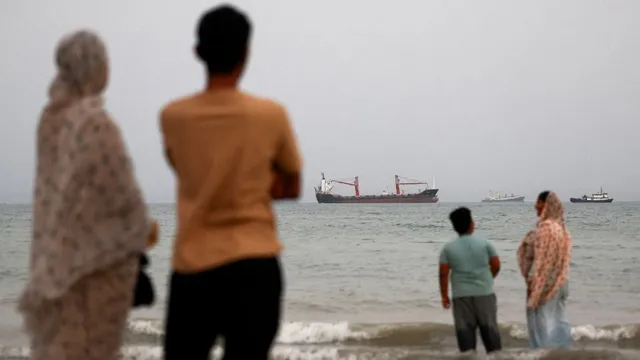
In the backdrop of these developments, talks mediated by Oman regarding the reopening of the Strait of Hormuz to shipping are reportedly nearing a breakthrough. Iran's foreign ministry has indicated that discussions have reached their 'final' stages, with both parties close to an agreement on new shipping routes through the strait. However, Iran has made it clear that it will not fully reopen the waterway until the U.S. addresses its behavior, which includes lifting the naval blockade, ceasing military actions, and compensating for war damages.
The situation remains tense, as a ceasefire reached in June collapsed shortly after due to disputes over control of the strait, leading to renewed fighting. Iran has continued to conduct intermittent strikes on U.S. bases in Kuwait, Bahrain, and Jordan, while the Houthis in Yemen, aligned with Tehran, have declared a separate naval blockade against Saudi Arabia. Recent reports have also highlighted growing friction between Washington and Israel regarding the pace of U.S. efforts to de-escalate conflicts in multiple regions, including Gaza and Lebanon.

Comprehensive report
Full story,
in detail.
Trace the developments that led here, see how the story evolved, and understand the forces and wider context surrounding it.