
Topic overview
Briefly
- Blanche confirmed as AG in 50-49 Senate vote, with two Republicans opposing.
- In first DOJ address, he called for unity and promised integrity.
- On Sunday, he said he would consider Trump's opinions on prosecutions.
What happened
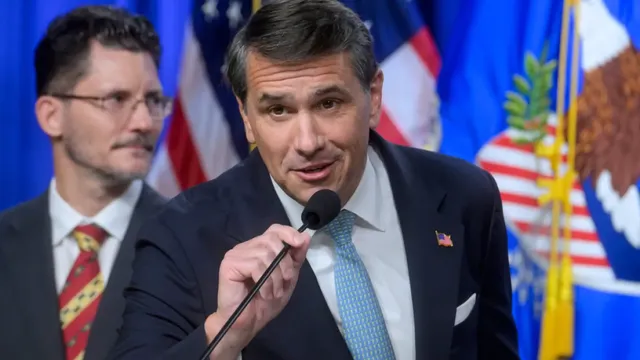
Attorney General Todd Blanche, in his first address to the Justice Department workforce on Thursday, called for unity and promised to lead the agency with integrity, leaving it "more faithful to its highest ideals than when I found it." Speaking in the Great Hall at DOJ headquarters in Washington, he praised career employees and encouraged disagreement as a means to make better decisions. This conciliatory tone came after a year of major changes under President Donald Trump, including mass departures, firings, and investigations into the president's perceived political enemies, which critics have claimed is a misuse of the nation's top law enforcement arm. Blanche, who previously served as Trump's criminal defense lawyer, was confirmed by the Senate in a narrow 50-49 vote, with two Republicans opposing him over concerns about politicization. He had been acting attorney general since April, following the removal of Pam Bondi. During his confirmation, Democrats and watchdog groups argued that his close ties to Trump would weaken the DOJ's independence. In his address, Blanche acknowledged he would not get every decision right but promised to respect the judiciary and reject "performative attacks that undermine the institutions that we are sworn to uphold." The DOJ currently has over 500 job openings, indicating a depleted workforce. The question of who will become deputy attorney general remains open, with Associate Attorney General Stanley Woodward, who worked with Blanche on Trump's defense team, as a possible contender.
On Sunday, in an interview on NBC's "Meet the Press," Blanche said "of course" he would listen to President Trump's opinions on prosecutions. When asked if he would take Trump's view into consideration if the president said a case should be revived, Blanche responded affirmatively, arguing that any attorney general would consider the president's views. He dismissed the notion that Trump calls him to order prosecutions, saying, "There is this extraordinarily false narrative that the president wakes up in the morning and calls me and says, 'Todd, go prosecute X or Y.' He does not do that. He has never done that. He will never do that." He also said he would always stand up for what is right and that the president does not expect his leaders to just say yes to him. This stance has reignited concerns about the DOJ's independence, which were central to his confirmation battle. Blanche declined to pledge that the DOJ would always act independently of the White House, saying no attorney general should make such a commitment. He argued that a president is entitled to communicate priorities to the DOJ. When asked if he would refuse a presidential request that crossed legal or ethical lines, Blanche said such a scenario would never arise, stating, "The president will never ask me to do something unethical or illegal." These comments have drawn criticism from legal experts, with University of Michigan law professor Barb McQuade calling it "an appalling departure" from the DOJ's mission and accusing Blanche of turning it into "Trump's private law firm."
Blanche also addressed other topics during the interview. He defended the DOJ's efforts to obtain voter registration data from states ahead of the November midterm elections, saying the federal government has a role in ensuring elections comply with federal law. He also defended Trump's pardoning of 1,500 supporters convicted of attacking the US Capitol, saying it was the president's right. When asked about the possibility of pardoned attackers receiving settlements from the federal government, Blanche declined to speculate, but he did say that a $1.8 billion "anti-weaponization" fund for allies whom Trump considered unfairly prosecuted was dead. The interview came days after his narrow confirmation, and his comments are likely to keep the debate over DOJ independence at the forefront as he settles into his role. The context also includes a case involving U.S. Attorney Jeanine Pirro, who moved to dismiss federal charges against former Olympian David Hearn after evidence showed damage to the Reflecting Pool at the Lincoln Memorial was caused by a botched renovation. Trump called on Pirro to revive the case, but she has not reversed her decision. Blanche said he "certainly" listens to Trump when he opines on social media or speaks to the American people about making the country safer.

Comprehensive report
Full story,
in detail.
Trace the developments that led here, see how the story evolved, and understand the forces and wider context surrounding it.