
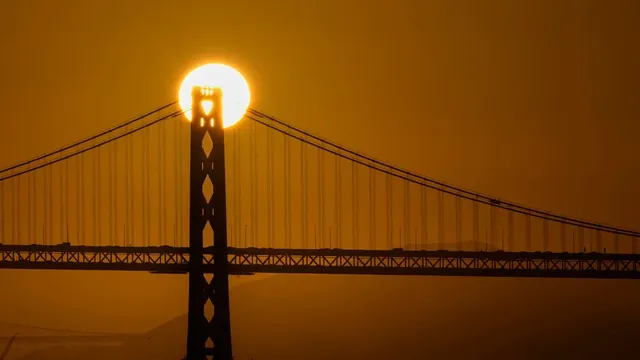
Topic overview
Briefly
- Earth tilts toward sun in summer, giving northern latitudes longer daylight hours
- Western locations in time zones see later sunsets than eastern locations year-round
- Northern latitudes lose daylight faster as seasons change toward winter
What happened
The phenomenon of varying sunset times across the Bay Area stems from a combination of Earth's axial tilt and geographical positioning within time zones. During summer months, the Northern Hemisphere tilts toward the sun, resulting in longer daylight hours at higher latitudes. This fundamental astronomical principle explains why Santa Rosa, located in the North Bay, experiences its last 8 p.m. sunset on August 18, while San Francisco sees its final 8 p.m. sunset on August 16, and San Jose and Santa Cruz already marked theirs on August 14.
The east-west orientation within a time zone creates an additional layer of complexity in sunset timing. Locations situated on the western edges of time zones consistently experience later sunsets than their eastern counterparts because the sun sets in the west. This geographic reality means that northwestern locations benefit from both the latitudinal advantage of being farther north and the longitudinal advantage of being farther west. The interplay between these two factors creates invisible diagonal lines across time zones where locations hundreds of miles apart share identical sunset times, such as Santa Monica and Ridgecrest both experiencing their last 8 p.m. sunset on July 25.
The seasonal shift brings a dramatic reversal of this pattern as the Northern Hemisphere begins tilting away from the sun. Northern latitudes lose daylight at a significantly faster rate than southern locations during the transition to winter. By October 1, San Francisco and Medford, Oregon, will share the same sunset time despite their considerable latitudinal difference. This convergence demonstrates how the summer advantage of northern locations diminishes as autumn progresses. The winter solstice presents the most extreme version of this reversal, with northern areas experiencing much earlier sunsets than their southern neighbors.
The consistency of the east-west effect throughout the year provides a stable baseline for understanding sunset variations. While the latitudinal advantage shifts dramatically with the seasons, the western edge of any time zone will always experience later sunsets than the eastern edge. This permanent geographic advantage explains why Santa Cruz and San Jose, despite Santa Cruz being farther south, shared the same last 8 p.m. sunset date. Santa Cruz's western position compensates for its southern latitude, creating an equilibrium with San Jose's more eastern but more northern location. The complex interaction between these geographical and astronomical factors produces the diverse sunset patterns observed across the Bay Area and beyond.

Comprehensive report
Full story,
in detail.
Trace the developments that led here, see how the story evolved, and understand the forces and wider context surrounding it.