
Topic overview
Briefly
- Moroccan police arrested 111 people attempting to enter Ceuta on Saturday.
- Spain and Morocco have deployed additional security forces to the border.
- The arrests follow social media calls for a second mass crossing after July's surge.
What happened
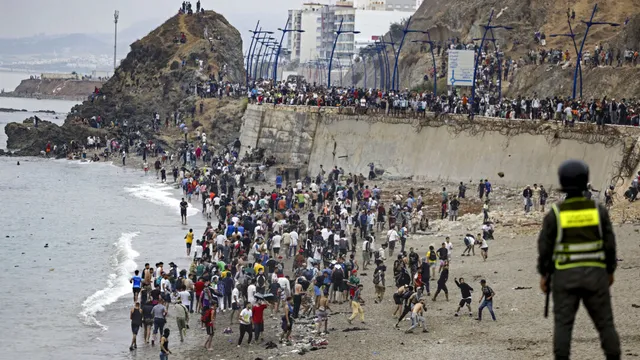
On Saturday, two weeks after a mass crossing that saw over 72,000 people enter Spain's North African enclave of Ceuta, Moroccan police arrested at least 111 people as they attempted to cross the border. The arrests occurred amid tightened security on both sides of the border following social media calls for another mass migrant surge. According to a source in Morocco's Interior Ministry, those detained included 109 migrants from sub-Saharan Africa and two Moroccan citizens, all arrested in or around Fnideq, the Moroccan city opposite Ceuta. Spanish news agency EFE reported that Moroccan police used tear gas to disperse groups of migrants gathered on hills about three kilometers from the border. Reuters later observed hundreds of police officers, some in riot gear and others in plainclothes, returning from the hills outside Fnideq. EFE and Spanish state broadcaster TVE said Morocco's Interior Ministry ordered their journalists to leave Fnideq immediately without explanation.
In Ceuta, Spanish soldiers guarded supermarkets while police heavily patrolled the main streets. The city was calmer than in the days following the July 30 crossing, which resulted in at least 96 deaths. Madrid has since installed a maritime barrier and deployed more than 500 additional police officers from mainland Spain, raising the total in Ceuta to over 1,600. Spain's Interior Minister Fernando Grande-Marlaska stated that reinforcements would remain as long as needed and that migrants who entered irregularly would not be allowed to stay, travel to the mainland, or obtain legal status, except in rare cases of extreme vulnerability. Those without a right to remain would be returned to Morocco.
The attempted crossing came after social media posts incited another mass rush, prompting Morocco to deploy hundreds of soldiers and police to the border. Morocco's Interior Ministry condemned the calls as criminalized acts of incitement and arrested several individuals who circulated them. The ministry also called on Spain to continue returning the remaining Moroccan migrants in Ceuta. Of the more than 72,000 who rushed the border in July, the vast majority have returned to Morocco, with about 5,000 remaining. Spanish officials have been screening the remaining migrants and have processed roughly 500 asylum applications, rejecting most.
The situation has sparked political tensions. Ceuta's Mayor-President Juan Jesús Vivas called for suspending the right to asylum in cases of mass border invasion and demanded the immediate return of migrants. Morocco's Justice Minister Abdellatif Ouahbi accused Madrid of undercutting Morocco's border controls, saying intercepted migrants now ask why they are stopped if Spain accepts them. He warned that two states sharing borders cannot pursue contradictory policies and threatened to suspend the extradition treaty with Spain. Both governments have blamed human trafficking networks for spreading misinformation about Spain's migration policies. The crisis has also drawn international attention, with far-right parties using it to push anti-immigration rhetoric.

Comprehensive report
Full story,
in detail.
Trace the developments that led here, see how the story evolved, and understand the forces and wider context surrounding it.