
Topic overview
Briefly
- Astronomers have compiled a 2D map of the universe that charts 4 billion celestial objects.
- The map was created over 13 years using data from three ground-based sky surveys.
- This map is expected to aid in future astronomical research and enhance our understanding of the universe.
What happened
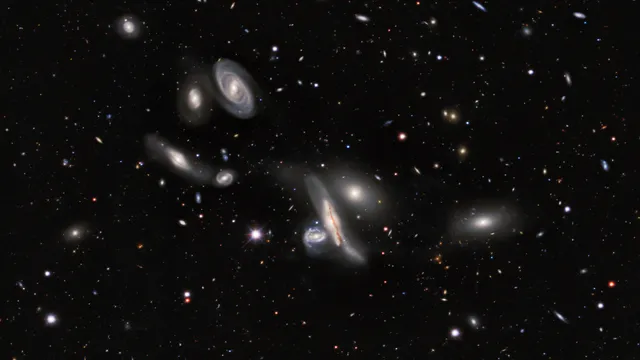
In a groundbreaking achievement, astronomers have compiled the largest 2D map of the universe, which charts 4 billion celestial objects, including stars, galaxies, black holes, and asteroids. This monumental project, which took over a decade to complete, utilized data from three extensive ground-based sky surveys conducted by the National Science Foundation and the University of Arizona. The map covers approximately three-quarters of the night sky in high resolution, spanning both visible and near-infrared light wavelengths, and focuses on areas of the universe that are not obscured by dust or gas.
The creation of this map is significant not only for its sheer scale but also for its potential applications in ongoing and future astronomical research. The data gathered will serve as a valuable resource for other telescopes, enabling astronomers and citizen scientists to combine their observations with the map to enhance their understanding of the universe. This collaborative approach is expected to facilitate the search for rare cosmic phenomena, such as gravitational lenses and supernovae, while also addressing two of the most pressing mysteries in physics: dark matter and dark energy.
The implications of this map extend beyond mere cataloging of celestial objects. It is anticipated to inform new observational projects, including the Vera C. Rubin Observatory and the Nancy Grace Roman Space Telescope. These initiatives aim to deepen our understanding of the cosmos and the fundamental forces that govern it. Furthermore, the map has laid the groundwork for the Dark Energy Spectroscopic Instrument (DESI) survey, which is currently working on creating a 3D map of the universe by measuring the light from celestial objects to determine their distances.
As the first five-year survey of DESI concluded in April, early results suggest that dark energy may be weakening over time, raising important questions about the future of the universe. The ongoing work of DESI, which is set to continue until 2028, promises to yield even more data and insights, further enhancing our understanding of the cosmos and the forces that shape it.

Comprehensive report
Full story,
in detail.
Trace the developments that led here, see how the story evolved, and understand the forces and wider context surrounding it.