
Topic overview
Briefly
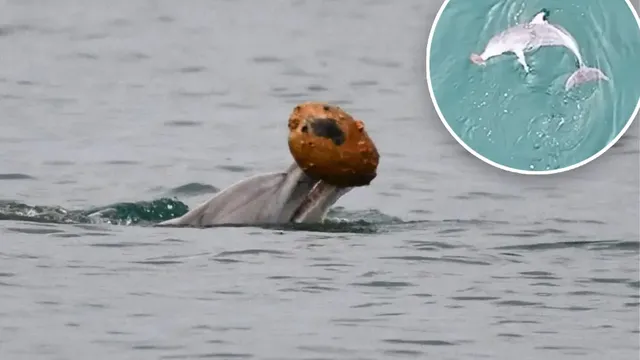
- Dolphins in Australia were filmed using shells to trap fish for the first time.
- The behavior was previously observed in 2013 but never captured on video.
- A mother and calf were seen shelling together, suggesting the behavior is learned from mothers.
What happened
In a groundbreaking marine observation, researchers have captured the first video evidence of dolphins using shells as tools to catch prey. The footage, recorded in 2025 off the coast of Hervey Bay in Queensland, Australia, shows a female Pacific bottlenose dolphin raising a large empty seasnail shell above the water, then dropping it to trap fish that had taken refuge inside. This behavior, known as "shelling," had been previously observed in 2013 in Shark Bay, Western Australia, but never before documented on video. The study, published in the journal Marine Mammal Science, was led by Alexis Levengood, a marine mammal biologist at the University of the Sunshine Coast. Levengood described her excitement upon witnessing the event, saying she was screaming with joy because the team had realized they were seeing something extraordinary. The video captures the dolphin holding the shell aloft, then dropping it into the water, and quickly snatching a fish that escaped from the shell. This technique effectively flushes prey into the shell, which then acts as a temporary trap, allowing the dolphin to drain the fish into its mouth. The significance of this discovery extends beyond the mere novelty of the behavior. In a second clip from the same location, a mother and her calf were seen shelling together. The mother surfaced with a shell, the fish inside escaped, and she dropped the shell to chase it. Moments later, the calf picked up the shell and held it in the same manner as its mother. This observation provides the first potential evidence of maternal social transmission, meaning the calf learned the behavior by observing its mother, rather than from peers. This finding challenges previous assumptions about how tool use spreads among dolphin populations. The fact that shelling has now been observed in two distinct locations, thousands of miles apart, raises intriguing questions about the origins and spread of this behavior. Levengood noted that the two populations may have independently invented or innovated this technique, or there could be other populations in between that also practice shelling but have not yet been documented. The discovery has broader implications for understanding tool use in non-human animals and its evolutionary parallels with human development. By studying how dolphins learn and use tools, scientists hope to gain insights into the cognitive and cultural processes that may have shaped human evolution. The footage from Hervey Bay is a testament to the intelligence and adaptability of dolphins, and it underscores the importance of continued research into marine mammal behavior. The study was published in Marine Mammal Science, and the findings have been reported by various media outlets, including the BBC and ScienceAlert. The research team, led by Levengood, was on a research vessel when they made the observation, and their excitement was palpable. The video evidence not only confirms the existence of shelling but also provides a rare glimpse into the social learning mechanisms that underpin this sophisticated hunting strategy. As scientists continue to analyze the footage, they hope to learn more about the frequency of shelling, its success rate, and the conditions that favor its use. The discovery also highlights the need for further studies on dolphin populations in other regions to determine whether shelling is a widespread phenomenon or a localized innovation. Ultimately, this finding adds to the growing body of evidence that dolphins are among the most intelligent and culturally complex animals on the planet, and it offers a fascinating window into the evolution of tool use in the animal kingdom.

Comprehensive report
Full story,
in detail.
Trace the developments that led here, see how the story evolved, and understand the forces and wider context surrounding it.