
Topic overview
Briefly
- Japan's economy grew at a 1.1% annual pace in the April-June quarter, faster than forecast.
- U.S. stocks fell from all-time highs after a report showed shoppers spent less at retailers last.
- The Strait of Hormuz is nearly closed, blocking a vital route for Middle East oil and gas tankers.
What happened
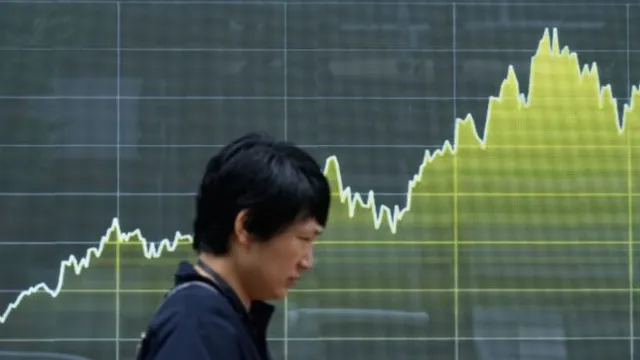
Asian stock markets showed a predominantly positive trend on Monday, with several major indices recording gains, while U.S. futures and oil prices remained relatively stable. This market behavior followed a pullback in U.S. stocks from their record highs at the end of the previous week, triggered by a disappointing U.S. retail sales report. The economic data from Japan provided a notable bright spot, as the government announced that the economy expanded slightly faster than anticipated during the April-June quarter. The annualized growth rate reached 1.1%, and on a quarterly basis, the economy grew by 0.3% in the second quarter. This expansion occurred despite stagnant private spending and investment, as well as a slowdown in export growth, suggesting underlying resilience in the world's third-largest economy.
In specific market movements, Tokyo's Nikkei 225 index added 0.3% to reach 68,929.33, buoyed by the positive domestic growth figures. Chinese markets also performed well, with Hong Kong's Hang Seng index climbing 1.6% to 25,521.99 and the Shanghai Composite index rising 0.8% to 3,960.19. Taiwan's Taiex gained 0.5%, contributing to the overall positive sentiment in the region. However, not all markets shared in the gains; Australia's S&P/ASX 200 slipped 0.4% to 9,076.90, and India's Sensex fell 0.5%. Markets in South Korea were closed for a holiday, limiting the full regional picture. The mixed performance reflects ongoing investor caution about global economic conditions.
The U.S. market backdrop that influenced Asian trading was characterized by declines on Wall Street last Friday. The S&P 500 fell 0.2% after the retail sales report indicated that American shoppers reduced their spending in the previous month. This data presents a double-edged sword for investors: weaker consumer spending could encourage the Federal Reserve to maintain its low interest rate policy, which is generally favorable for stock valuations, but it also signals a potential slowdown in economic growth. The situation is complicated by persistently high inflation, creating a challenging environment where the Federal Reserve has limited tools to address both stagnating growth and rising prices simultaneously. This economic condition, often referred to as stagflation, is viewed as a worst-case scenario by many economists and investors.
Looking ahead, Wall Street is preparing for a week of significant financial updates, with earnings reports expected from some of the nation's largest retailers. These reports will provide further insight into the health of U.S. consumer spending. Additionally, the Federal Reserve is scheduled to release the minutes from its July policy meeting on Wednesday, which will offer more details about the central bank's interest rate policy deliberations. In commodity markets, oil prices showed mixed movements, with Brent crude edging 0.1% higher to $88.62 per barrel and U.S. benchmark crude slipping 0.3% to $82.19 per barrel. The stability of oil supplies remains a concern due to the uncertain prospects for a deal to end the conflict with Iran, with the Strait of Hormuz nearly closed, blocking a vital route for oil and gas tankers from the Middle East. In currency markets, the U.S. dollar weakened against the Japanese yen, falling to 159.09 from 159.32, while the euro saw a marginal decline against the dollar.

Comprehensive report
Full story,
in detail.
Trace the developments that led here, see how the story evolved, and understand the forces and wider context surrounding it.