
Topic overview
Briefly
- Hakeem Jeffries has not co-sponsored Medicare for All legislation, favoring a more cautious approach
- Ro Khanna claims worker income is at its lowest share since 1929 due to rising health insurance
- Khanna argues the fear of medical bankruptcy from a cancer diagnosis is a major economic roadblock
What happened
Representative Ro Khanna of California has articulated a forceful argument positioning Medicare for All as the central solution to a cascade of economic pressures facing American workers. His comments, made in the context of a broader Democratic Party debate on healthcare strategy, directly challenge the more incremental approach favored by party leadership, including House Minority Leader Hakeem Jeffries of New York. Khanna's core contention is that the current, predominantly employer-based health insurance system is not merely a healthcare issue but a fundamental economic roadblock that suppresses wages and fuels financial instability for millions of families.
Khanna grounded his argument in a specific historical economic claim, stating that the average income of workers has fallen to 43%, which he described as the lowest level since 1929. He drew a direct causal line from this statistic to the escalating cost of health insurance, arguing that the financial burden on employers to provide coverage directly prevents wage growth. In his view, the money that companies spend on rising insurance premiums is money that is not being passed on to employees in the form of higher salaries. By eliminating this cost through a single-payer, government-funded system, Khanna asserts that Medicare for All would unlock significant wage increases for the working class, fundamentally altering the economic landscape for tens of millions of people.
The congressman also highlighted the acute, personal financial terror associated with the current system, pointing to the pervasive fear of medical bankruptcy. He noted that for many Americans, a single serious diagnosis, such as cancer, can lead to financial ruin due to unaffordable medical bills. This personal dimension of economic insecurity, he argued, is a primary driver of hardship, pushing families into debt and creating a constant state of financial precarity. This perspective frames healthcare reform not as an abstract policy goal but as a direct intervention to prevent personal financial catastrophe, a message designed to resonate with voters' lived experiences.
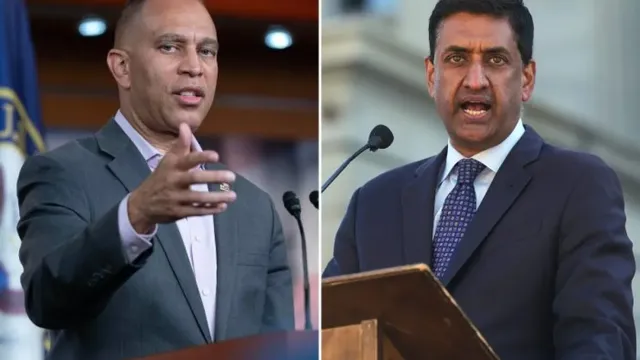
This stance places Khanna in direct opposition to the strategic vision laid out by Hakeem Jeffries. The House Minority Leader has explicitly stated that he has not co-sponsored Medicare for All legislation, advocating instead for a focus on lowering costs and protecting access within the existing framework. Jeffries' position suggests a belief that a more moderate, step-by-step approach to fixing the "broken healthcare system" is more politically viable and less disruptive. Khanna's full-throated endorsement of a comprehensive overhaul, labeling it his "most important priority" and the "single biggest roadblock in our economic system," thus represents a significant ideological and tactical fault line within the Democratic caucus regarding the scale and speed of healthcare reform.

Comprehensive report
Full story,
in detail.
Trace the developments that led here, see how the story evolved, and understand the forces and wider context surrounding it.