
Topic overview
Briefly
- Australia signed a new defense alliance with Fiji and similar pacts with other Pacific nations.
- Prime Minister Albanese stated China seeks regional influence and long-term hegemony.
- China criticized Australia's Pacific pacts as selfish and threatened by iron ore pricing.
What happened
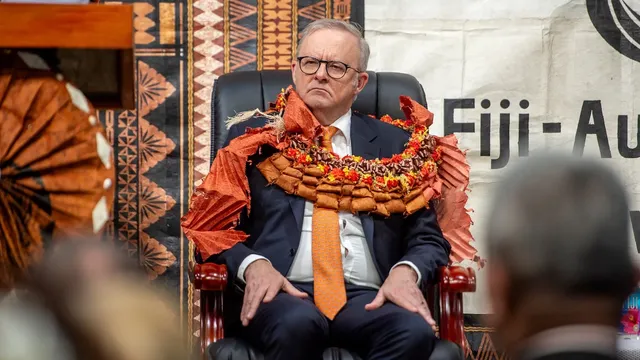
The relationship between Australia and China, despite a period of high diplomatic tension, has been underpinned by strong economic complementarity, particularly in the resources sector. Australia's iron ore trade with China has been a cornerstone of its national prosperity for three decades, a trade that neither side has been willing to use as leverage. The Albanese government, now in its second term, had maintained a disciplined approach to stabilizing the bilateral relationship. However, this stance has recently shifted, with Prime Minister Anthony Albanese adopting a more forthright tone regarding Beijing's strategic ambitions. In a recent interview with the New York Times, Albanese stated that the Chinese are "interested in increasing their influence at a minimum, and hegemony in the longer term." This marks the first time the prime minister has characterized China's ambitions in such direct terms.
This rhetorical shift is significant for two main reasons. First, it coincides with a flurry of new defense and security agreements that Canberra has been forging with Pacific Island nations. These include a new defense alliance with Fiji, following similar pacts with Papua New Guinea and Vanuatu, and policing arrangements with the Solomon Islands and Tuvalu. These moves are widely interpreted as an effort to limit China's strategic reach in the region. Second, the tougher language suggests that the "China threat" narrative, which has long been the prevailing view within Canberra's national security establishment, is once again becoming the dominant orthodoxy among Australian politicians. This indicates a move away from the previous "stabilization" mantra and a deeper commitment to ensuring the United States retains its primary strategic foothold in Asia.
The Albanese government's actions and rhetoric are increasingly viewed through the lens of alliance maintenance with the United States. Canberra is observing the economic and diplomatic pressure Tokyo faces from Beijing, including the arrest of Japanese businessmen and various economic measures, which reinforces the view that China is an unreliable trade partner. Australia's diplomatic successes in the Pacific are seen as part of a new "great game," where Canberra demonstrates to Washington that it is securing the region against Chinese influence. Former Australian Ambassador to China Geoff Raby noted that much of the prime minister's language on China in the Pacific is based on the premise that China desires military bases. In announcing deals with the Solomon Islands and Vanuatu, Albanese expressed confidence that these arrangements would prevent China from establishing a military foothold.
China has responded by toughening its own rhetoric and actions toward Australia. Beijing has criticized Canberra on several fronts, including the ownership of Darwin port, the new security pacts with Pacific countries, and a recent Australian missile test. The Chinese ambassador stated that the Albanese government's desire to return Darwin port to Australian ownership was "no way to do business." The Chinese Foreign Ministry also condemned the defense pact with Fiji as "selfish political games" that threaten Chinese interests. Furthermore, Beijing has been playing hardball on the price of iron ore. Despite these tensions, Australian public opinion remains complex. A recent Lowy Institute poll showed that 61 percent of Australians view China more as an economic partner than a security threat, and trust in China to act responsibly rose 8 points from 2025 to 28 percent. The shift in Albanese's tone may steer the relationship back to a more fraught state, raising the question of whether the national security establishment is adequately planning for a future with a dominant China.

Comprehensive report
Full story,
in detail.
Trace the developments that led here, see how the story evolved, and understand the forces and wider context surrounding it.