
Topic overview
In brief
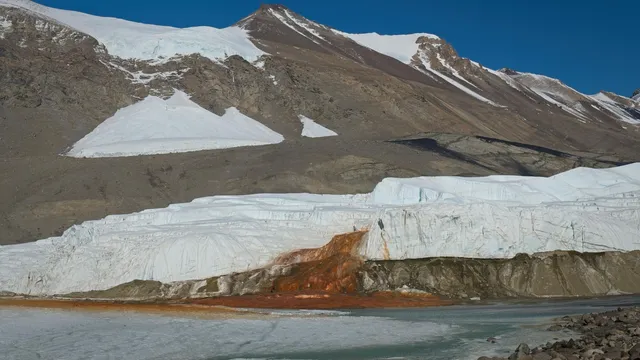
- Blood Falls in East Antarctica emits red brine rich in iron, suggesting a unique origin.
- Recent studies indicate that the brine likely comes from ancient seawater trapped beneath a glacier.
- The findings support the hypothesis of a seawater origin for the microorganisms present at Blood Falls.
Summary
In East Antarctica's Taylor Valley, a unique phenomenon known as Blood Falls has intrigued scientists for years. This waterfall, which emits a striking red brine, has been the subject of various studies aimed at uncovering its origins. Recent research has provided new insights, suggesting that the brine is composed of ancient seawater that became trapped beneath a glacier during a period when sea levels were higher than they are today. The study, published in the journal Nature Geoscience, highlights the presence of marine eukaryotic lineages in the Blood Falls area, indicating a significant connection to oceanic environments.
The research team analyzed 167 samples of water, sediment, and air from Blood Falls and the surrounding McMurdo Dry Valleys. Their findings revealed that the brine contained a higher proportion of eukaryotes, which are complex cells with a membrane-bound nucleus, compared to other sites in the Dry Valleys. Specifically, Blood Falls shared over 9% of its eukaryotic composition with nearby oceanic samples, while the broader Dry Valleys showed only about 1% similarity. This suggests that the microorganisms present in Blood Falls are remnants of ancient marine conditions, supporting the hypothesis of a seawater origin for the brine.