
Topic overview
Briefly
- A 2011 fire in the same Belgian reserve burned nearly 14 square kilometers.
- The current fire has burned about 30 square kilometers, more than double the 2011 area.
- Two people died on Salamina after gale-force winds spread the fire in seven minutes.
What happened
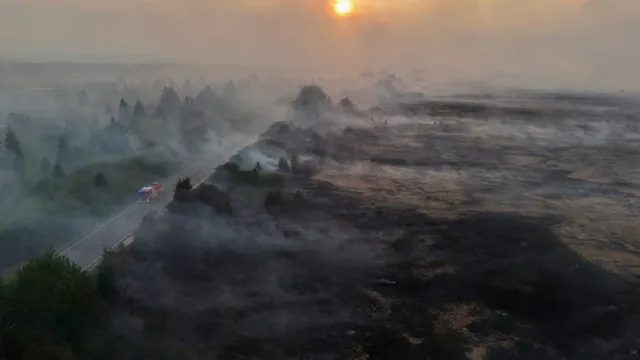
A series of severe wildfires broke out across Europe, fueled by hot and dry conditions. In eastern Belgium, a massive fire consumed approximately 30 square kilometers of the High Fens nature reserve, marking one of the country's worst wildfires in recent history. The blaze, which began in the Liège province near the German border, prompted the evacuation of about 600 residents from the municipalities of Waimes and Bütgenbach on Saturday as shifting winds spread smoke through the area. Nicolas Yernaux, a spokesperson for the Public Service of Wallonia, noted that the conditions were significantly worse than during a 2011 fire that burned nearly 14 square kilometers in the same region, because the soil was very dry. René Dahmen, chief engineer at the Department of Nature and Forest, confirmed the fire was still spreading on Sunday in terrain difficult for crews to access. Local authorities in Germany warned that the fire was approximately 1.5 kilometers from the border. In response, farmers from both Belgium and Germany used tanker trucks to pump water from a nearby lake to assist firefighters. Belgium activated the European Union's civil protection mechanism, leading to the deployment of two water-bombing aircraft from Sweden and three helicopters from the Netherlands and the Czech Republic. Temperatures in parts of Belgium had reached about 37 degrees Celsius on Friday.
In Greece, a separate wildfire on the island of Salamina, west of Athens, resulted in two fatalities on Sunday. Fire Brigadier General Vasileios Vathrakogiannis explained that near gale-force winds enabled the fire to reach dangerous proportions and spread rapidly within seven minutes toward nearby residential areas. A second blaze was also reported in the Selini area. The island had been placed at high wildfire risk that day.
Other parts of Europe also suffered. In France, a massive wildfire in the Gironde department burned approximately 420 square kilometers, forcing the evacuation of about 220,000 people as it moved toward the Atlantic coast and the Bordeaux area. In the United Kingdom, emergency crews, supported by military personnel, were fighting 14 wildfires in South Wales.
The widespread fires were a consequence of a broader heatwave affecting the continent, with record temperatures and exceptionally dry soil creating ideal conditions for fires to ignite and spread rapidly. The activation of the EU civil protection mechanism underscored the severity of the situation, requiring a coordinated international response to combat blazes that overwhelmed local resources. The events highlighted the immediate dangers of extreme weather, leading to loss of life, mass evacuations, and significant environmental damage across multiple nations.

Comprehensive report
Full story,
in detail.
Trace the developments that led here, see how the story evolved, and understand the forces and wider context surrounding it.