
Topic overview
In brief
- In March 2026, a supernova explosion was detected by China's Einstein Probe space telescope.
- The explosion, located 500 million light-years away, was confirmed as an Ic-BL supernova with unexpected characteristics.
- The collaboration of telescopes, including the Vera C. Rubin Observatory, is expected to provide long-term observations of the supernova's evolution.
Summary
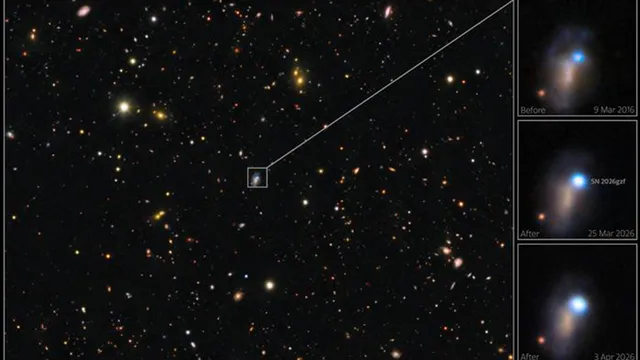
In March 2026, a supernova explosion was first detected by China's Einstein Probe space telescope, which observed a flash of X-rays. Ground-based telescopes quickly identified this flash as a supernova, marking a significant event in astronomical observations. The explosion, located 500 million light-years away, was confirmed as an Ic-BL supernova, a type often associated with gamma-ray bursts. However, this particular event surprised researchers as it exhibited the faintest shock breakout seen in such supernovae, and no gamma-ray bursts were detected. This lack of gamma-ray emissions led scientists to speculate that the jet might have been obstructed by the star's surface or surrounding material.
The Vera C. Rubin Observatory, which began its 10-year sky survey in late June 2026, played a crucial role in observing the supernova. It was fortuitously positioned to capture the explosion in the COSMOS Deep Drilling Field. The observatory's rapid observation capabilities and sensitivity are expected to yield detailed records of the supernova's evolution over the coming years. This collaboration among various telescopes allowed astronomers to track the light changes of the supernova and study the physics of the explosion, including the X-ray shock breakout and its interaction with previously expelled material from the dying star.