
Topic overview
Briefly
- Lyra is one of the sky's smallest constellations.
- The constellation represents the harp of the Greek poet Orpheus.
- Observers in the southern hemisphere can also see Lyra low in the north.
What happened
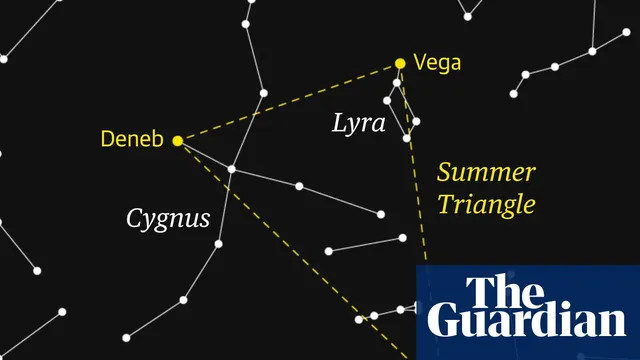
The constellation Lyra, representing the lyre or harp, is one of the smallest constellations in the night sky. It is easily located due to the presence of Vega, the fifth-brightest star. Vega is a brilliant white star that forms one corner of the prominent summer triangle asterism, alongside Deneb in the constellation Cygnus and Altair in Aquila. From the United Kingdom, Lyra appears high overhead after darkness falls during August evenings. The chart provided shows the view facing south and looking up towards the zenith from London at 22:30 BST on 17 August. Once Vega is identified, the rest of the constellation can be traced, although its other stars are much fainter.
Lyra has a significant historical and mythological background. It was catalogued as one of the original 48 constellations by the second-century astronomer Ptolemy. The constellation is noted for being a star pattern that visually resembles the object it is named after: a lyre. In Greek mythology, the lyre represents the instrument played by the poet Orpheus. Orpheus was a figure of such musical talent that his playing could charm wild animals, move rocks, and even sway the gods. His music was so powerful that it protected the crew of the Argo, of which he was a member, from the dangerous and beguiling songs of the Sirens.
The visibility of Lyra is not limited to the northern hemisphere. Observers in the southern hemisphere can also find the constellation during August evenings, though it will appear much lower in the northern part of their sky. The constellation's position and the brightness of Vega make it a notable feature for stargazers in many parts of the world during this time of year. The summer triangle, anchored by Vega, is a key navigational and observational feature of the summer night sky.
The story of Lyra and its primary star Vega connects modern astronomical observation with ancient cultural narratives. The constellation's compact shape and the brilliance of Vega provide an accessible entry point for amateur astronomers to explore the night sky. The mythological tales associated with Orpheus add a layer of cultural richness, linking the stars to stories of art, adventure, and the power of music that have been told for millennia. The constellation serves as a reminder of how ancient civilizations interpreted the heavens and how those interpretations have been passed down through history.

Comprehensive report
Full story,
in detail.
Trace the developments that led here, see how the story evolved, and understand the forces and wider context surrounding it.