
Topic overview
Briefly
- On August 10, 2026, the Long March 7A rocket launched from Hainan, China, but failed shortly after liftoff.
- The rocket was carrying the ChinaSat-4B satellite, intended for communication services.
- This incident marks the first failure of the Long March 7A since its maiden flight in 2020, raising concerns about future launches.
What happened
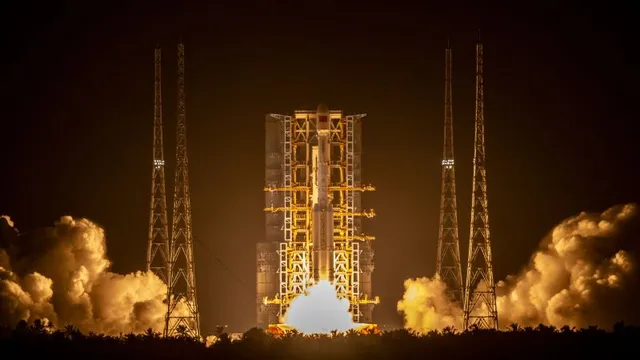
On August 10, 2026, a Long March 7A rocket, designed to carry the ChinaSat-4B satellite, experienced a catastrophic failure shortly after liftoff from the Wenchang Space Launch Site in Hainan, China. The rocket launched at 8:02 p.m. Beijing time but exploded just 85 seconds into its flight, resulting in the complete destruction of the vehicle and its payload. This incident marks a significant setback for China's space program, particularly for the Long March 7A, which had previously completed over a dozen successful missions since its first flight in March 2020.
The Long March 7A is a medium-lift rocket developed by the China Academy of Launch Vehicle Technology, a key player in China's space endeavors. The rocket is intended for high-orbit missions and has a capacity to deliver substantial payloads to geostationary transfer orbit. The failure of this mission is particularly notable as it was the first failure for the Long March 7A since its maiden flight, which also ended unsuccessfully due to an in-flight malfunction. Following the successful return to flight in 2021, the rocket had established a reliable track record until this recent incident.
The payload, ChinaSat-4B, was expected to provide essential communication services, including voice, data, radio, and television transmission. The satellite was part of a series that includes ChinaSat-4A, which was launched in 2024. The failure raises questions about the reliability of the Long March 7A and could lead to increased scrutiny of other upcoming launches, especially if investigators find shared components or operational issues at the Wenchang launch site.
In the wake of this failure, the launch of the Zhuque-3 rocket, which was scheduled for the following day, has been postponed. The Zhuque-3 is a significant project for China's private space sector, aiming to develop reusable rocket technology. This setback for the Long March 7A could have broader implications for China's ambitions in space exploration and its competitive stance against other nations, particularly the United States, in the realm of space technology and satellite deployment.

Comprehensive report
Full story,
in detail.
Trace the developments that led here, see how the story evolved, and understand the forces and wider context surrounding it.