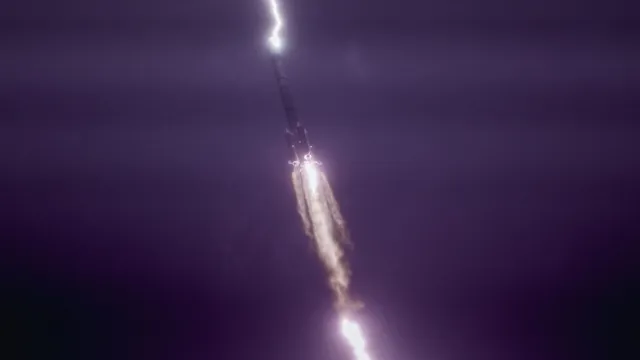
On July 23, 2023, a Long March 3B rocket launched from the Xichang Satellite Launch Center in southwest China. Approximately 30 seconds after liftoff, the rocket was struck by a bolt of lightning, which was witnessed by hundreds of spectators. Despite the intense electrical discharge, estimated at over 100 million volts, the rocket continued its ascent and successfully deployed its payload, the Tianlian-2 (06) satellite, into orbit. This satellite is intended to support China's Tiangong space station.
Modern rockets, including the Long March 3B, are designed with highly conductive shells that protect their internal systems from electrical charges, functioning similarly to a Faraday cage. This design allows them to withstand lightning strikes without sustaining damage. The successful mission was confirmed by the China Aerospace Science and Technology Corp., which declared it a complete success.
Historically, lightning strikes on rockets during launch are rare but not unprecedented. Notable incidents include NASA's Apollo 12 mission in 1969, where the Saturn V rocket was struck by lightning twice shortly after launch, yet it still completed its mission to the moon. More recently, in 2019, a Russian Soyuz rocket was also struck by lightning while carrying a communications satellite into orbit. These events highlight the resilience of modern spacecraft and the advancements in engineering that allow them to endure such extreme conditions.
While rockets are typically launched in favorable weather to minimize risks, the occurrence of lightning strikes during launches is a reminder of the unpredictable nature of weather. Launchpads are often equipped with lightning protection systems, but incidents can still occur. The Long March 3B's successful mission after being struck by lightning serves as a testament to the robustness of current aerospace technology and the ongoing efforts to ensure the safety and reliability of space missions.