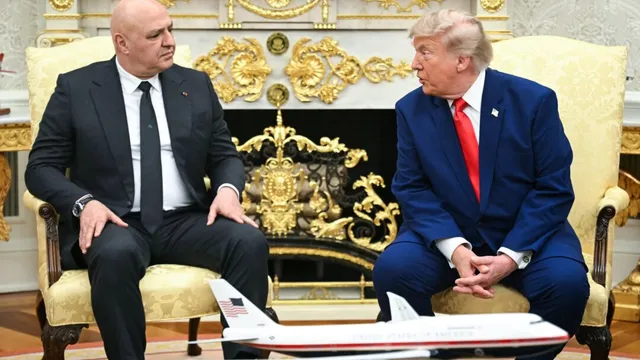
Lebanon's president seeks Israeli troop withdrawal in meeting with Trump
politics
controversial
impactful

Lebanon's president seeks Israeli troop withdrawal in meeting with Trump

41
(Update: )
sovereign state in Western Asia
country primarily in North America
president of the United States from 2017 to 2021
  • Joseph Aoun is concluding a four-day visit to Washington, D.C., to meet with President Donald Trump.
  • The discussions focus on achieving long-term stability in Lebanon and the withdrawal of Israeli troops from southern Lebanon.
  • The outcome of these talks could significantly impact the future of Lebanon and its relations with Israel.
Share opinion
4

Story

Lebanon's president, Joseph Aoun, is concluding a four-day visit to Washington, D.C., where he is meeting with U.S. President Donald Trump. This meeting is part of Lebanon's efforts to achieve long-term stability following months of conflict involving Israel and the Iran-backed Hezbollah militant group. The discussions come at a critical time as Lebanon and Israel engage in rare direct talks mediated by the United States, aiming to facilitate the withdrawal of Israeli troops from southern Lebanon. The Lebanese government hopes that these negotiations will lead to a framework agreement that includes the disarmament of Hezbollah, which has maintained a significant presence in the region for decades. The U.S. State Department has announced the initiation of operations in three villages that are part of a designated pilot zone, although specific details have not been disclosed. Two of these villages, Froun and Srifa, are currently under the control of the Lebanese army, while Israeli forces remain present in part of Zawtar al-Gharbieh. The Lebanese military has stated that it is preparing for the withdrawal of Israeli troops from Zawtar al-Gharbieh and has begun deploying additional forces to the area. Local officials, including the mayor of Zawtar al-Gharbieh, have expressed concerns about safety due to the proximity of Israeli military operations. In a related development, Secretary of State Marco Rubio met with Aoun and reaffirmed U.S. support for the framework agreement aimed at stabilizing Lebanon. Rubio emphasized that Lebanon cannot achieve lasting peace without addressing the issue of Hezbollah, suggesting that a strong government capable of disarming non-state groups is essential. He also highlighted the need for international investment to rebuild Lebanon's infrastructure, which has been severely damaged by ongoing conflicts. The Lebanese government, which came to power on a reformist platform in early 2025, has vowed to disarm all non-state groups, including Hezbollah, which it blames for escalating tensions with Israel. Despite these diplomatic efforts, skepticism remains among some Lebanese citizens regarding the potential for military confrontation with Hezbollah, which could lead to further civil unrest. Hezbollah has dismissed the U.S.-brokered talks and instead supports negotiations between the U.S. and Iran to resolve the broader conflict, including the situation in Lebanon. The backdrop of these discussions includes a recent history of violence, with the Israeli military's ground invasion and airstrikes in Lebanon resulting in significant casualties and displacement of civilians. The ongoing conflict has left over 4,000 people dead and displaced approximately 1.2 million others, underscoring the urgent need for a resolution to the crisis.

Context

The Lebanon-Israel conflict has deep historical roots, primarily stemming from territorial disputes, national identity, and the broader Arab-Israeli conflict. The modern phase of this conflict can be traced back to the mid-20th century, particularly after the establishment of the State of Israel in 1948. This event led to the displacement of a significant number of Palestinians, many of whom sought refuge in Lebanon. The influx of Palestinian refugees exacerbated existing tensions in Lebanon, where various sectarian groups vied for power and influence. The situation was further complicated by the Lebanese Civil War (1975-1990), during which various factions, including the Palestine Liberation Organization (PLO), engaged in armed conflict, often drawing in external actors such as Syria and Israel. The PLO's presence in Lebanon was viewed by Israel as a direct threat, leading to military interventions and operations aimed at neutralizing this perceived danger. In 1982, Israel launched a full-scale invasion of Lebanon, known as Operation Peace for Galilee, with the stated aim of expelling the PLO from the country. This invasion resulted in significant casualties and destruction, particularly in Beirut, and led to the eventual withdrawal of the PLO. However, the conflict did not end there; instead, it gave rise to the emergence of Hezbollah, a Shiite militant group that positioned itself as a resistance movement against Israeli occupation. Hezbollah's influence grew in the 1990s, and it became a key player in Lebanese politics, often clashing with Israeli forces along the border. The conflict reached a new peak in 2006 when a cross-border raid by Hezbollah led to a month-long war with Israel, resulting in widespread devastation in Lebanon and significant loss of life on both sides. The aftermath of the 2006 war saw a fragile ceasefire, but tensions remained high. Israel continued to view Hezbollah as a significant threat, while Hezbollah maintained its stance of resistance against Israeli actions. The situation was further complicated by the Syrian civil war, which began in 2011, as Hezbollah intervened in support of the Assad regime, further entrenching its role in regional geopolitics. The conflict has also been influenced by broader regional dynamics, including the rivalry between Iran and Israel, with Hezbollah receiving support from Iran, which has fueled Israeli concerns about a so-called "Shia crescent" stretching from Iran through Iraq and Syria to Lebanon. As of 2026, the Lebanon-Israel conflict remains unresolved, with periodic flare-ups and ongoing skirmishes along the border. The situation is characterized by a complex interplay of local, regional, and international factors, making a lasting peace elusive. Efforts at diplomacy have been sporadic, often hindered by mutual distrust and the lack of a comprehensive peace agreement. The humanitarian situation in Lebanon, compounded by economic crises and political instability, continues to affect the dynamics of the conflict. The legacy of historical grievances, territorial disputes, and the ongoing struggle for national identity ensures that the Lebanon-Israel conflict will remain a significant issue in Middle Eastern politics for the foreseeable future.