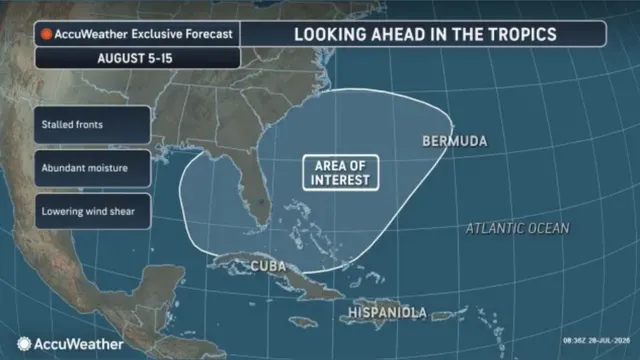
In the southeastern United States, particularly around Florida, the Carolinas, Cuba, the Bahamas, and Bermuda, meteorologists are closely monitoring conditions that may lead to the formation of tropical weather systems. AccuWeather has reported that while no immediate tropical activity is expected following the recent storm Bertha, the region could become more susceptible to tropical developments in early to mid-August. The forecast indicates that a broad zone near the U.S. coast may have the highest chance of producing a tropical depression or rainstorm during the first two weeks of August. This is particularly concerning as the area is close to land, which could lead to sudden weather changes.
Forecasters have noted that the atmospheric pressure in the region is expected to be lower than in surrounding areas, which could facilitate the development of thunderstorms. AccuWeather's Lead Hurricane Expert Alex DaSilva explained that fronts moving into the area are likely to weaken, while warm waters will support tropical activity. Additionally, wind shear may decrease compared to earlier weeks this summer, creating a more favorable environment for storm formation.
One potential scenario involves a cluster of thunderstorms organizing into an area of low pressure, which could then separate from a decaying front. If this occurs, the system may begin to exhibit tropical characteristics, such as a warm core and rotation, rather than behaving like a typical nontropical storm. The concern is that if a storm were to develop quickly near the coast, it could bring heavy rain, coastal flooding, and damaging winds with minimal notice.
As the Atlantic hurricane season progresses, AccuWeather continues to expect a below-average to average season overall, largely due to the influence of a strong El Niño, which tends to suppress tropical activity in the Atlantic. The National Oceanic and Atmospheric Administration (NOAA) has also predicted a below-normal hurricane season, estimating eight to fourteen named storms, including three to six hurricanes and one to three major hurricanes. This outlook reflects a significant decrease from the average season, which typically produces fourteen named storms, seven hurricanes, and three major hurricanes.