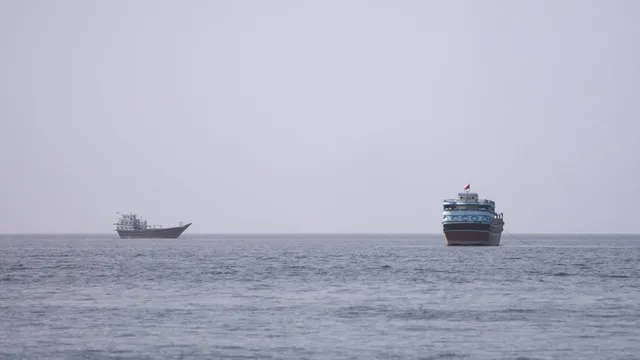
In recent days, the U.S. military has intensified its operations against Iran by launching strikes on two strategically significant islands, Abu Musa and Greater Tunb, located at the confluence of the Persian Gulf and the Strait of Hormuz. These islands have long been a point of contention, with their ownership disputed between Iran and the United Arab Emirates. The U.S. military's actions come amid an expanding campaign against Iran, which has raised concerns about the potential for further escalation in the region.
The largest of the islands, Abu Musa, is primarily used by Iran's paramilitary Revolutionary Guard as a base for military operations, including the deployment of fast boats and missiles. These assets have been utilized to harass shipping in the Strait of Hormuz, a critical maritime route for global oil transportation. The historical context of the islands dates back to November 30, 1971, when Iran, under the rule of Shah Mohammad Reza Pahlavi, seized control of them just before the formation of the United Arab Emirates. At that time, the U.S. provided little resistance to Iran's actions, viewing the Shah as a key ally in the region.
Following the 1979 Islamic Revolution, Iran has continued to use these islands as strategic military bases, particularly during the Tanker War of the 1980s, when U.S. Navy vessels escorted oil tankers through the region under threat from Iranian forces. U.S. estimates indicate that Iran attacked over 160 ships during this period, leading to heightened tensions and military confrontations. The recent U.S. strikes on the islands have reignited discussions about their ownership and strategic importance, with some analysts suggesting that American forces might consider a more permanent military presence in the area.
The United Arab Emirates has actively sought to resolve the dispute over the islands through international channels, lobbying both China and Russia to support negotiations or court decisions regarding their ownership. This diplomatic effort has angered Tehran, which views any external intervention as a direct challenge to its sovereignty. As the conflict continues to escalate, the fate of these islands remains uncertain, with the potential for significant geopolitical ramifications in the region. The U.S. military's actions may force the issue to a head, nearly 55 years after the Shah warned that the Strait of Hormuz could become a "nuisance" for the world, highlighting the ongoing volatility and strategic significance of this critical maritime chokepoint.