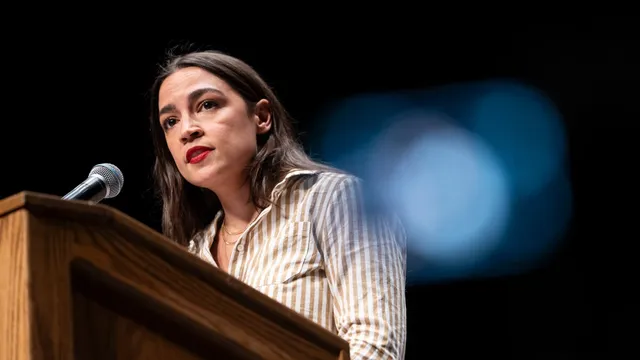
In a recent hypothetical Democratic primary survey conducted by The Public Sentiment Institute (TPSI) from July 25-29, 2026, among 762 likely voters in Michigan, Alexandria Ocasio-Cortez has emerged as a notable contender for the 2028 presidential nomination. However, the poll indicates that she is currently trailing behind several prominent candidates. Former Transportation Secretary Pete Buttigieg leads the poll with 24.2 percent support, while Ocasio-Cortez garners only 10.7 percent, placing her third among named candidates. The survey also reveals that a significant 21.7 percent of respondents remain undecided, highlighting the uncertainty and volatility of the early stages of the race. This suggests that many Democratic voters have yet to solidify their preferred candidate for the upcoming election.
In addition to Buttigieg and Ocasio-Cortez, Georgia Senator Jon Ossoff is in second place with 13.9 percent support, while California Governor Gavin Newsom and former Vice President Kamala Harris follow closely with 10.0 percent and 5.1 percent, respectively. Other candidates, including Illinois Governor JB Pritzker and Pennsylvania Governor Josh Shapiro, have garnered minimal support, with 3.8 percent and 3.6 percent, respectively. The presence of a large number of undecided voters indicates that the primary race is still in its formative stages, and candidates have time to sway public opinion.
Early prediction markets also reflect a competitive landscape for the Democratic nomination. As of the latest updates, Newsom is seen as a frontrunner with an 18-19 percent chance of winning, while Ocasio-Cortez and Ossoff are tied at around 13-14 percent. Harris, Buttigieg, Shapiro, and Pritzker have lower probabilities of securing the nomination, indicating that the race is still wide open. The dynamics of the race may shift as candidates ramp up their campaigns and engage with voters in the coming months.
Despite her current standing, Ocasio-Cortez's presence in the race is significant, as she represents a younger generation of Democratic leaders advocating for progressive policies. Her campaign could potentially resonate with voters who prioritize issues such as healthcare, workers' rights, and women's rights. However, the challenge remains for her to convert undecided voters and gain traction against established political figures. As the primary season approaches, the evolving political landscape will be crucial in determining the eventual nominee for the Democratic Party in 2028.