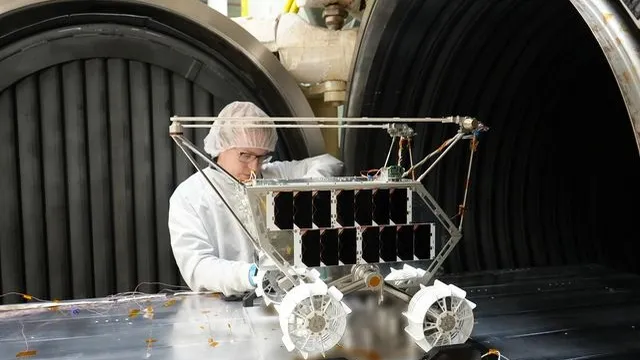
In recent months, Lunar Outpost, a startup focused on building robotics for space infrastructure, announced its plans to deploy Nvidia Jetson chips on its next moon rover. This initiative marks a significant step in the use of GPUs beyond Earth, as the Jetson platform is expected to be the first GPU on the lunar surface. The CEO of Lunar Outpost, Justin Cyrus, highlighted the importance of comparing the Jetson chips with their existing flight compute platform, which has more spaceflight heritage, to determine the advantages and disadvantages of each system. The goal is to enhance the capabilities of their rovers in extreme environments like the moon.
NASA has been actively encouraging private companies to explore the lunar surface in preparation for the return of human astronauts, potentially as early as 2028. In line with this, Nvidia has partnered with Firefly Aerospace, the first private company to successfully land a robot on the moon. This partnership will see the Jetson platform utilized on a satellite orbiting the moon, which aims to collect data for scientists mapping the lunar surface and monitoring the increasing number of robots operating there.
The Jetson platform, while not as widely recognized as Nvidia's other AI products, plays a crucial role in physical AI systems. It is designed to be compact and energy-efficient, enabling robotic systems to process sensor inputs locally. This capability allows for quicker understanding and reaction to environmental changes, which is essential for autonomous operations in space. Cyrus noted that their autonomy stack has evolved over the past five years, integrating both deterministic models and physical AI to enhance decision-making processes.
Operating GPUs in space presents unique challenges due to the harsh conditions on the moon, including exposure to cosmic radiation and extreme temperature fluctuations. Most GPUs used in space are typically in low Earth orbit, where they are somewhat shielded from these factors. If Lunar Outpost can successfully implement the Jetson chips in the lunar environment, it could lead to more capable rovers that can process information and make decisions more rapidly. The company is focused on transitioning from exploration to establishing a permanent presence on the moon, which includes developing a robotic workforce to support human activities in space.