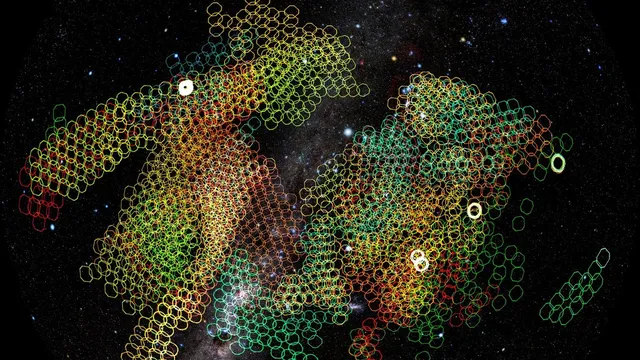
In Chile, the Vera C. Rubin Observatory has initiated the most extensive and ambitious survey of the night sky ever undertaken. This monumental project, known as the Legacy Survey of Space and Time (LSST), aims to capture a comprehensive view of cosmic events, particularly focusing on transients—objects that change in brightness or position over time. The observatory features an impressive 8.4-meter mirror and the largest digital camera ever built, equipped with 3.2 billion pixels, allowing it to gather vast amounts of data over its ten-year mission.
The LSST is designed to revisit each area of the sky more than 800 times, resulting in millions of images that will document a staggering array of astronomical phenomena. Among the anticipated discoveries are 20 billion galaxies, 17 billion stars, 10 million supernovae, and six million solar system objects. The ability to detect supernovae is particularly significant, as each new observation contributes to our understanding of the universe and its expansion.
Additionally, the observatory is expected to identify over 100,000 near-Earth objects (NEOs), including asteroids and comets that come within 50 million kilometers of Earth. This capability will enhance our knowledge of these celestial bodies and their potential impact on our planet. The search for Planet Nine, a hypothesized large planet in the outer solar system, may also be bolstered by the LSST's findings, as it will help refine the orbits of trans-Neptunian objects (TNOs).
One of the most exciting aspects of the LSST is the potential for unexpected discoveries. As astronomers analyze the data collected, they anticipate encountering phenomena that challenge current understanding and prompt new questions about the universe. This survey represents a significant leap forward in astronomical research, promising to unveil the mysteries of the cosmos and reshape our comprehension of the night sky.