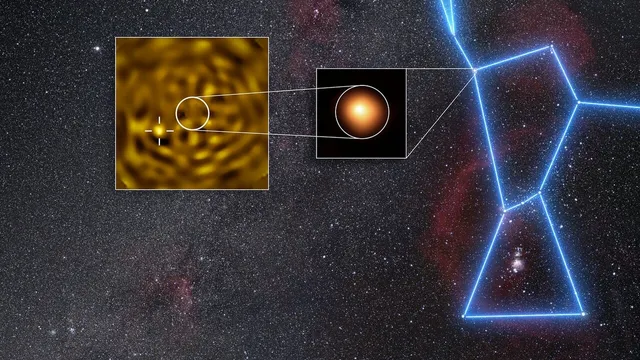
Betelgeuse, a prominent star located in the constellation Orion, holds significant importance in the field of astronomy due to its unique characteristics and its role in the study of stellar evolution. As a red supergiant, Betelgeuse is one of the largest stars visible to the naked eye, with a diameter approximately 1,000 times that of our Sun. Its immense size and brightness make it a key object of study for astronomers, providing insights into the life cycles of massive stars. Betelgeuse is classified as a variable star, exhibiting fluctuations in brightness that can be attributed to pulsations in its outer layers. This variability not only captivates amateur astronomers but also serves as a valuable tool for researchers to understand the physical processes occurring in such massive stars.
The significance of Betelgeuse extends beyond its physical attributes; it also plays a crucial role in the study of supernovae. As a star nearing the end of its life cycle, Betelgeuse is expected to explode as a supernova within the next million years, a relatively short time frame in astronomical terms. This impending event provides a unique opportunity for scientists to observe and study the final stages of a star's life. The explosion of Betelgeuse will be visible from Earth, potentially outshining the Moon and providing a spectacular display for observers. Such an event will not only enhance our understanding of supernova mechanisms but also contribute to our knowledge of the chemical enrichment of the interstellar medium, as the materials expelled during the explosion will seed future generations of stars and planets.
Moreover, Betelgeuse has been a focal point in discussions about the distance measurement in astronomy. Its parallax measurements have contributed to refining the cosmic distance scale, which is essential for understanding the structure and expansion of the universe. The star's distance from Earth is estimated to be around 640 light-years, although this figure has been subject to revision as measurement techniques improve. Accurate distance measurements are vital for determining the luminosity and other intrinsic properties of stars, which in turn aids in the classification of stars and the understanding of their evolution.
In summary, Betelgeuse is not only a visually striking star but also a cornerstone in the study of stellar evolution, supernova phenomena, and cosmic distance measurement. Its impending transformation into a supernova presents an unparalleled opportunity for astronomers to observe and learn from one of nature's most dramatic events. As research continues, Betelgeuse will undoubtedly remain a subject of fascination and a key player in advancing our understanding of the universe.