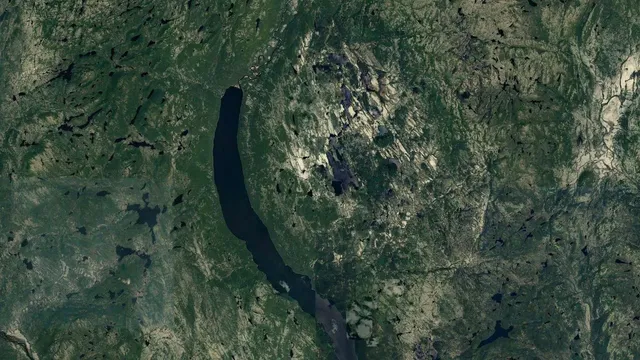
In 2024, an amateur astronomer named Joël Lapointe discovered a large pit while using Google Maps to plan a camping trail in Quebec's Côte-Nord region. The pit, which is approximately 25 kilometers (15.5 miles) in diameter, was initially thought to be a simple indentation in the terrain. However, upon further investigation, scientists confirmed that it is an ancient meteor impact crater dating back roughly 390 million years. The crater, centered around Lake Marsal, exhibits a near-perfect ring shape, which is atypical for natural ditches.
Lapointe's discovery led him to contact French geophysicist Pierre Rochette, who noted that the surrounding topography strongly suggested an impact crater. Initial tests of samples retrieved from the site revealed the presence of zircon, a mineral often formed during meteor impacts. However, the presence of zircon alone was insufficient to definitively prove the crater's extraterrestrial origin. To confirm the findings, a team of scientists visited the site to conduct further examinations.
During their visit, the scientists observed features known as shatter cones, which are grooves or lines in the rock's surface caused by shockwaves from a meteor impact. They also found cliffs of impact melt rock, formed by the extreme temperatures and pressures generated during the impact event. The team collected samples from the site and conducted dating analyses, ultimately determining that the crater is approximately 390 million years old. This discovery is significant as it adds to the understanding of meteor impacts and their effects on Earth's geology, biology, and climate.
The crater has been named Uhaachatik Crater, following discussions with the Ekuanitshit Innu council, which represents the indigenous people in the area. Lapointe expressed his excitement upon learning that his discovery had been confirmed as a genuine meteor crater, encouraging others to trust their observations, even if they are outside their field of expertise. The research team, led by Osinski, plans to continue studying the collected samples to gain further insights into the impact site and its implications for understanding the history of meteor impacts on Earth.