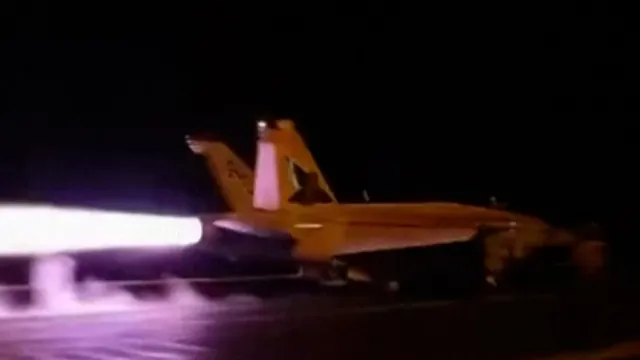
US military strikes Iranian targets in response to attacks on troops
military conflicts
impactful
controversial

US military strikes Iranian targets in response to attacks on troops

10
(Update: )
country in Western Asia
president of the United States from 2017 to 2021
country primarily in North America
Iranian Islamic Revolutionary Guard Corps unit
country in Western Asia
  • The US military launched strikes against Iranian targets linked to the IRGC in response to missile attacks on American troops in Jordan.
  • The strikes targeted various military facilities and aimed to reduce threats to US forces and commercial shipping.
  • The situation reflects a deteriorating security environment in the Middle East, with ongoing hostilities complicating peace efforts.
Share opinion
1

Story

On July 29, 2026, the US military conducted a series of strikes against targets associated with Iran's Islamic Revolutionary Guards Corps (IRGC) in response to recent Iranian attacks on American troops stationed in Jordan. The strikes, which lasted approximately two hours, targeted military command centers, missile and drone facilities, coastal surveillance and defense sites, as well as Iran's maritime capabilities. This military action was a direct response to Iran's confirmation of firing ballistic missiles at US military bases in Jordan, which had escalated tensions in the region. The situation has been exacerbated by a breakdown of a June memorandum of understanding aimed at pausing hostilities to facilitate peace talks. Both the US and Iran have resumed military operations, raising concerns about the potential for a wider conflict in the Middle East. Iran has also been involved in attacks on commercial vessels in the strategically important Strait of Hormuz, further complicating the security landscape in the region. In the wake of these developments, experts have expressed concern over the escalating cycle of violence. Allison Minor, a director at the Atlantic Council, noted that the US is in a challenging position, facing an ongoing escalatory spiral that is difficult to navigate. The Iranian regime has signaled its intent to dictate the terms of the conflict, demonstrating a willingness to confront the US militarily. Additionally, the Egyptian cabinet reported that a drone attack linked to Iran caused a fire at a US-owned gas storage tanker in Damietta, marking the first attack on a target in Egypt since the conflict began. In Kuwait, an Iranian attack resulted in significant damage to a building owned by a Chinese company, leading to casualties. Despite the ongoing violence, Pakistan has indicated that negotiations between the US and Iran are still taking place, particularly regarding the situation in the Strait of Hormuz, although details remain scarce. President Donald Trump has acknowledged the ongoing talks but has also indicated that military operations could resume if negotiations do not yield results.

Context

The history of the US-Iran conflict is marked by a series of events that have shaped the geopolitical landscape of the Middle East. The roots of the conflict can be traced back to the early 20th century, particularly with the 1953 CIA-backed coup that overthrew Iran's democratically elected Prime Minister Mohammad Mossadegh. This event led to the establishment of the Shah's authoritarian regime, which was supported by the United States. The Shah's rule was characterized by widespread repression and human rights abuses, which fueled resentment among the Iranian populace and laid the groundwork for the 1979 Iranian Revolution. This revolution resulted in the establishment of the Islamic Republic of Iran, which was fundamentally opposed to US influence in the region and led to the severing of diplomatic ties between the two nations. The hostage crisis that followed the revolution, where 52 American diplomats and citizens were held hostage for 444 days, further exacerbated tensions. The US responded with economic sanctions and diplomatic isolation of Iran, which continued to escalate over the years. The Iran-Iraq War (1980-1988) saw the US providing support to Iraq, further straining relations. In the 1990s, the US labeled Iran as part of the "Axis of Evil" and imposed additional sanctions, particularly in response to Iran's nuclear ambitions and its support for militant groups in the region. The early 2000s marked a significant turning point with the US invasion of Iraq in 2003, which removed Iran's regional rival, Saddam Hussein. This shift in power dynamics allowed Iran to expand its influence in Iraq and the broader region, leading to increased tensions with the US and its allies. The nuclear issue became a focal point of the conflict, culminating in the 2015 Joint Comprehensive Plan of Action (JCPOA), an agreement aimed at curbing Iran's nuclear program in exchange for sanctions relief. However, the US withdrawal from the agreement in 2018 under the Trump administration reignited hostilities, leading to a series of confrontations, including the assassination of Iranian General Qassem Soleimani in 2020. As of 2026, the US-Iran conflict remains unresolved, with ongoing tensions over Iran's nuclear program, its regional activities, and the impact of sanctions on the Iranian economy. The Biden administration has expressed a desire to return to negotiations regarding the nuclear deal, but significant obstacles remain, including Iran's ballistic missile program and its support for proxy groups in the region. The conflict continues to have profound implications for regional stability, US foreign policy, and the broader international community, as both nations navigate a complex web of historical grievances, strategic interests, and geopolitical rivalries.