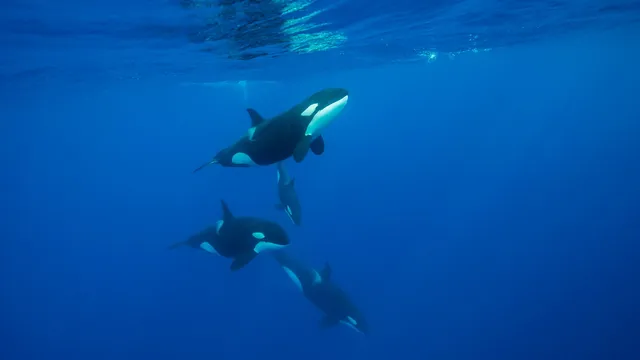
In July 2024, researchers in the Gulf of California, Mexico, witnessed a remarkable behavior among orcas, known for their intelligence and hunting prowess. During two separate encounters, the orcas demonstrated a coordinated effort to break apart the carcasses of dead sharp-tail sunfish, a species that can weigh up to 4,400 pounds. One orca held the sunfish in place while another charged at it, resulting in the carcass being fragmented into smaller pieces. This behavior was not an attempt to hunt live prey, as the sunfish were already dead and appeared to have been disemboweled.
The first encounter was documented near an offshore seamount off Baja California Sur, where an adult female orca stabilized the sunfish while an adult male orca accelerated towards it. The impact was so powerful that it shattered the tissue of the sunfish, scattering fragments throughout the water. This observation was captured on video, revealing the astonishment of the researchers, particularly Ayres, who noted the unprecedented nature of the impact.
The researchers proposed several theories regarding this behavior. It could be a food processing technique that allows younger orcas to feed more easily on the large fish. Alternatively, it might be a playful activity or a method to disperse the sunfish's microbe-rich skin and gelatinous tissue, potentially benefiting the orcas in some way. However, experts emphasized that more observations are needed to determine whether the adults were intentionally teaching the younger whales or if the behavior was purely instinctual.
This new behavior adds to the growing body of knowledge about orca intelligence and social dynamics. Previous studies have documented orcas using similar ramming techniques when hunting larger prey, such as whale sharks. The recent findings highlight the adaptability and problem-solving skills of these marine mammals, suggesting that they may be capable of developing new strategies in response to their environment and available resources.