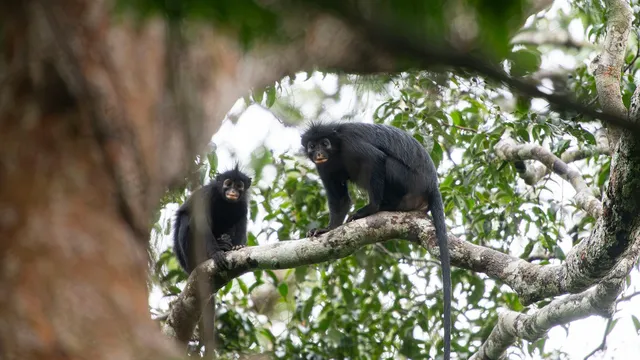
In the dense rainforests of the Democratic Republic of the Congo, researchers have identified a new species of monkey, named Colobus congoensis, which has distinctive orange lips and unique vocalizations. This discovery marks a significant event in primate research, as it is only the fifth new monkey species identified in Africa in the last 75 years. The research team, led by Junior Amboko, began their investigation after capturing images of an unidentified monkey in Lomami National Park in 2008. Subsequent sightings and local knowledge helped confirm the existence of this new species.
Between 2018 and 2022, the researchers conducted extensive fieldwork, recording 114 sightings of the monkeys across an area of approximately 660 square miles. The monkeys typically live in groups of one to twenty individuals and are primarily glossy black with a notable orange patch around their mouths and noses. Their vocalizations, which include deep roars and distinctive snorts, set them apart from other colobus monkeys. The team utilized genetic analysis to confirm that these monkeys were indeed a previously unknown species, revealing significant divergence from other colobus monkeys.
The discovery of Colobus congoensis not only adds to the biodiversity of the region but also reshapes our understanding of African monkey evolution. The closest relatives of this new species are found over 750 miles away in West Africa, indicating a complex evolutionary history. This finding highlights the importance of conservation efforts in the Congo rainforest, as there may be more undiscovered species in the region. The research underscores the critical role of local communities in wildlife conservation, as their knowledge was instrumental in identifying the new species.
Overall, the identification of Colobus congoensis is a remarkable achievement in primate research, emphasizing the need for continued exploration and conservation of tropical rainforests. The study not only contributes to the scientific understanding of primate diversity but also raises awareness about the threats faced by these unique species in their natural habitats.