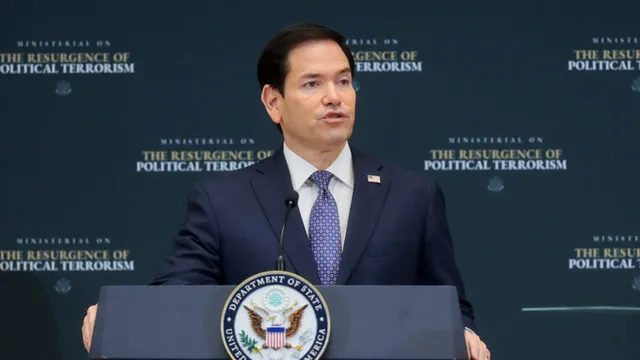
Marco Rubio addresses global leaders on left-wing political terrorism
politics
controversial
impactful

Marco Rubio addresses global leaders on left-wing political terrorism

21
(Update: )
American politician (born 1971)
president of the United States from 2017 to 2021
American political party
  • Marco Rubio convened a conference with leaders from over 60 countries to address left-wing political terrorism.
  • He emphasized the need to combat the rising threat of political violence attributed to leftist groups.
  • Rubio's remarks reflect a broader Republican narrative framing leftist extremism as a significant danger to American values.
Share opinion
2

Story

In a significant gathering, Secretary of State Marco Rubio convened leaders from more than 60 countries to discuss the rising threat of left-wing political terrorism. This event took place as part of the Trump administration's efforts to address what they term 'left-wing' political violence, a pressing issue for Republicans as they approach the midterm elections. Rubio's remarks highlighted the alarming rise of political violence attributed to leftist groups, which he argued has been largely ignored by many in positions of power. He emphasized the need for a united front against this form of terrorism, which he believes poses a serious threat to democratic values and societal stability. Rubio's perspective is deeply influenced by his background as the son of Cuban immigrants who fled the communist regime of Fidel Castro. He articulated that the ideological underpinnings of leftist terrorism stem from a hatred of civilization itself, describing it as a revolt against the strong and the good. This rhetoric aligns with the broader narrative pushed by the Trump administration, which has consistently framed the Democratic Party's left wing as a radical threat to American values. Rubio's speech also referenced a report from the Center for Strategic and International Studies, which indicated that left-wing terrorism incidents had surpassed those from the far right for the first time in over three decades, although the data suggests that the overall levels of violence remain low. The conference also saw Treasury Secretary Scott Bessent discussing financial strategies to combat these groups, indicating a shift in focus towards domestic threats using counterterrorism tools previously reserved for international issues. This approach reflects a growing concern among U.S. officials about the implications of leftist violence, particularly in light of recent political developments, including the election of democratic socialists in key positions. Rubio's call to action was clear: the threat of leftist terrorism must be taken seriously, and institutions that have historically downplayed this issue need to reassess their stance. In conclusion, Rubio's address serves as a rallying cry for Republicans and their allies to confront what they perceive as a rising tide of leftist extremism. The implications of this discourse extend beyond politics, as it raises questions about the nature of political violence and the responsibilities of democratic societies to protect themselves from all forms of terrorism. The urgency of the situation, as articulated by Rubio, suggests that the fight against left-wing political terrorism is not just a political issue but a fundamental challenge to the fabric of democracy itself.

Context

The history of left-wing political terrorism in the United States is a complex narrative that spans several decades, characterized by various groups and movements that have employed violence to achieve their ideological goals. The roots of left-wing terrorism can be traced back to the early 20th century, with the rise of anarchist movements and socialist organizations that sought to challenge the capitalist system. Notable incidents during this period include the 1919 bombings orchestrated by anarchists, which targeted prominent figures and institutions, reflecting a broader discontent with the socio-economic conditions of the time. As the century progressed, the civil rights movement and anti-war protests in the 1960s catalyzed a new wave of radical leftist groups, such as the Weather Underground and the Black Panthers, who believed that direct action was necessary to combat systemic oppression and imperialism. These groups often resorted to bombings, armed confrontations, and other forms of violence, which they justified as a means of revolutionary struggle against an unjust state. The 1970s and 1980s saw a continuation of left-wing terrorism, albeit with a shift in tactics and focus. The emergence of eco-terrorism, particularly through groups like Earth First!, highlighted a growing concern for environmental issues, leading to acts of sabotage against corporations and government entities perceived as harmful to the planet. Additionally, the rise of the Puerto Rican independence movement, exemplified by the Armed Forces of National Liberation (FALN), showcased how leftist ideologies intersected with national liberation struggles, resulting in violent actions aimed at achieving political autonomy. Throughout these decades, the federal government responded with increased surveillance and counter-terrorism measures, often labeling these groups as domestic terrorists, which further fueled the cycle of violence and repression. In the late 20th and early 21st centuries, left-wing political terrorism in the U.S. has evolved, with new movements emerging in response to contemporary issues such as globalization, racial injustice, and economic inequality. The anti-globalization protests of the late 1990s and early 2000s, particularly the Seattle WTO protests, saw a resurgence of militant tactics among some factions, leading to clashes with law enforcement and property destruction. More recently, the rise of groups like Antifa has sparked debates about the nature of left-wing activism and the boundaries of acceptable protest. While many participants advocate for non-violent resistance, there have been instances of violence and property damage that have drawn criticism and concern from various sectors of society. Overall, the history of left-wing political terrorism in the United States reflects a broader struggle over power, ideology, and social justice. It is marked by a diverse array of movements that have sought to challenge the status quo through radical means. Understanding this history is crucial for contextualizing current political dynamics and the ongoing debates surrounding activism, violence, and the role of government in addressing social grievances. As the landscape of political activism continues to evolve, the legacy of left-wing terrorism serves as a reminder of the complexities and challenges inherent in the pursuit of social change.