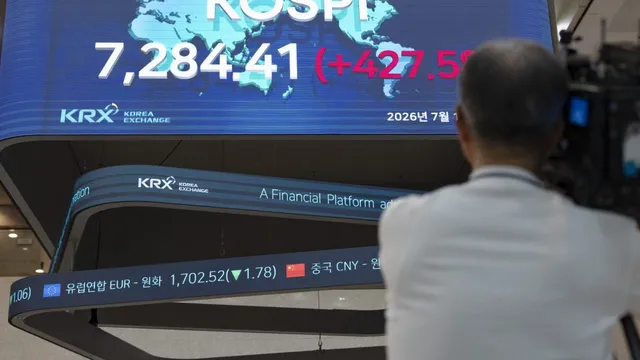
Korea's equity market, valued at $4 trillion, has emerged as a significant player in global investment dynamics, particularly in the technology sector. Investors are closely monitoring the Korean market for insights into risk appetite, especially as fluctuations in major companies like Samsung Electronics and SK Hynix impact global chip stocks. Recent trading patterns have shown that sentiment-driven trading in Korea is increasingly influencing global AI stocks, with the Kospi index experiencing notable volatility. This trend was particularly evident when a local selloff occurred, leading to a nearly 9% drop in the Kospi, which subsequently affected Wall Street markets.
The correlation between the Kospi and the Nasdaq 100 has reached a two-year high, indicating that movements in the Korean market are now closely tied to those in the U.S. tech sector. Analysts have noted that the Kospi's performance is now a key indicator for U.S. investors, with many adjusting their strategies based on developments in Korea. This shift has prompted investment firms to incorporate the Kospi into their daily monitoring routines, reflecting its growing importance in the global market landscape.
Despite the current turbulence, the Kospi remains one of the best-performing indices globally, up 62% for the year. However, the ongoing market rout has raised concerns about the sustainability of this growth, particularly as major chipmakers in Korea have seen their stock values decline significantly. The influence of Korea's market on global stocks is a double-edged sword; while it offers insights into market trends, it also exposes investors to heightened volatility.
As the market continues to evolve, experts suggest that the dynamics between Korea and global markets will remain a focal point for investors. The increasing sensitivity of the Nasdaq to the Kospi indicates a shift in how global markets interact, with Korea's performance now serving as a pre-market indicator for U.S. AI and semiconductor risks. This interconnectedness highlights the need for investors to stay informed about developments in Korea, as they can have far-reaching implications for global investment strategies.