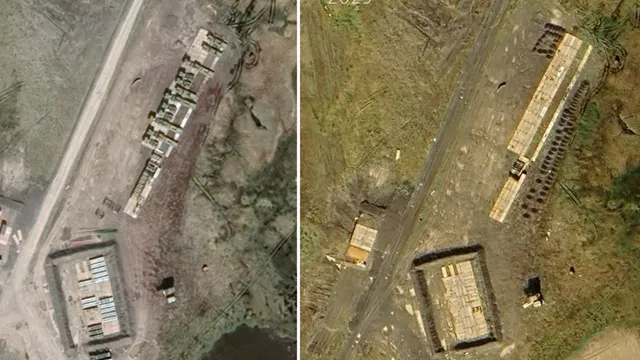
In recent months, satellite images have revealed that several key military sites in Russia's far north have seen a significant reduction in air defense capabilities. This change appears to be a strategic decision by the Kremlin, which is currently facing challenges in countering Ukrainian drone attacks that have targeted various military and energy infrastructure sites across the country. Notably, the Rogachevo air base in the Novaya Zemlya archipelago, which has been operational since at least August 2015, has had most of its air defense assets removed, indicating a shift in military priorities.
Katarzyna Zysk, a professor at the Norwegian Institute for Defense Studies, commented on the situation, suggesting that the removal of air defense systems reflects a growing mismatch between the targets that Russia needs to protect and the available resources, including launchers, interceptors, and trained personnel. While she noted that this does not mean that Russian strategic sites are entirely without air defense, it does imply that the Kremlin does not foresee an imminent large-scale attack in the far north region, allowing for a reduction in protective measures.
The ongoing drone campaign from Ukraine has primarily focused on sites directly linked to Russia's military operations, such as airfields used for bombing runs and energy infrastructure. Investigations have shown that approximately 60 percent of Russia's S-300 and S-400 air defense systems have been relocated from their original positions since the onset of the Ukraine conflict in 2022. Despite the withdrawal from the far north, air defense units have largely remained stationed around critical areas, including nuclear missile silos and strategic bomber airfields.
In Severodvinsk, a city on the White Sea known for its nuclear submarine construction and repair facilities, several air defense sites that had been in place for decades are now devoid of their systems. Recent images indicate that around two dozen S-300 and S-400 systems have been removed from their designated locations. The relocation of these systems has been linked to the combat death of Lieutenant Colonel Vladimir Spiridonov, who was killed in Crimea in April 2024, highlighting the ongoing impact of the conflict on military resources. As air defense systems are withdrawn from the far north, new deployments have been observed near locations that are more likely to be targeted by Ukrainian drones, such as the Saratov oil refinery, which has experienced multiple drone strikes since early 2025. This evolving situation raises questions about the future of Russia's air defense strategy, particularly whether the Kremlin will revert to a more concentrated deployment of air defense systems or adopt a more dispersed approach in response to the changing dynamics of the conflict.