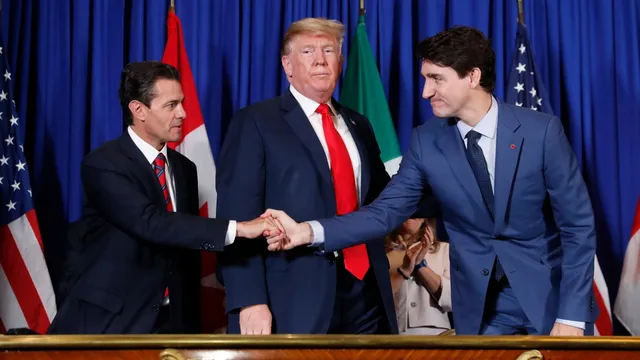
US negotiations threaten North America's economic stability
business
controversial
informative

US negotiations threaten North America's economic stability

10
(Update: )
country primarily in North America
country in North America
  • Negotiations over the USMCA have focused on tariffs and rules of origin.
  • Uncertainty in the legal framework could undermine investment confidence.
  • The outcome of these negotiations will impact North America's economic cooperation.
Share opinion
1

Story

In recent months, officials from the United States, Canada, and Mexico have engaged in negotiations regarding the future of the United States-Mexico-Canada Agreement (USMCA). The discussions have primarily revolved around tariffs, rules of origin, and the relative bargaining power of each nation. This negotiation process has raised concerns about the potential undervaluation of the foundational elements that contribute to the economic and strategic strength of the United States. For over three decades, North America has been recognized as a significant economic success, characterized by integrated supply chains and cross-border investments that have fostered a high level of economic cooperation among the three countries. The legal and institutional frameworks established by governments have provided businesses, investors, and workers with the confidence needed to make long-term investments. However, the current negotiations introduce uncertainty into this framework, which has been a cornerstone of North American integration for generations. Companies typically refrain from investing substantial amounts in factories and infrastructure unless they can rely on a stable legal environment. This predictability has been a competitive advantage for North America, often overlooked in discussions about economic power. The negotiations surrounding the USMCA are not merely about trade agreements; they are pivotal in determining whether the United States will continue to prioritize predictability as a strategic asset. The potential shift in the legal framework could lead to a less stable environment for investment and economic cooperation. The historical context of North America’s economic success is rooted in its democratic neighbors and integrated markets, which have fostered decades of legal cooperation. The current situation raises questions about the future of this cooperation and the implications for economic resilience in the region. As the negotiations progress, the uncertainty surrounding the legal framework may become a strategic tool in the bargaining process. This uncertainty could affect investment decisions, supply chains, and long-term strategic planning for businesses operating in North America. The outcome of the USMCA negotiations will have lasting implications for the economic landscape of the region, potentially reshaping the dynamics of trade and cooperation among the United States, Canada, and Mexico.

Context

Economic cooperation between the United States, Canada, and Mexico has been a cornerstone of North American relations, significantly impacting trade, investment, and economic growth in the region. The foundation of this cooperation can be traced back to the North American Free Trade Agreement (NAFTA), which was implemented in 1994. NAFTA aimed to eliminate trade barriers and promote economic integration among the three countries. In 2018, NAFTA was replaced by the United States-Mexico-Canada Agreement (USMCA), which modernized trade rules and addressed contemporary issues such as digital trade, labor rights, and environmental standards. This agreement has further solidified the economic ties between the three nations, fostering a more balanced and equitable trading environment. The economic interdependence of the U.S., Canada, and Mexico is evident in various sectors, including agriculture, manufacturing, and technology. The three countries collectively represent one of the largest trading blocs in the world, with billions of dollars exchanged daily. For instance, the U.S. is Canada's largest trading partner, while Mexico is the second-largest. This interconnectedness has led to increased job creation and economic growth across the region. The automotive industry serves as a prime example, where supply chains span all three countries, allowing for efficient production and distribution of vehicles. Such collaboration not only enhances competitiveness but also drives innovation and investment in new technologies. In addition to trade, economic cooperation extends to investment flows among the three nations. U.S. companies have invested heavily in Canada and Mexico, taking advantage of lower labor costs and favorable business environments. Conversely, Canadian and Mexican firms have also made significant investments in the U.S. market. This cross-border investment has facilitated knowledge transfer, skill development, and the establishment of joint ventures, further strengthening economic ties. Moreover, the three countries have engaged in various initiatives to promote sustainable development and address shared challenges, such as climate change and public health. Looking ahead, the future of economic cooperation among the U.S., Canada, and Mexico will likely be shaped by ongoing global economic trends and challenges. Issues such as supply chain resilience, technological advancements, and geopolitical tensions will require the three nations to adapt and collaborate more closely. The COVID-19 pandemic has underscored the importance of robust economic partnerships, as countries navigate recovery and strive for sustainable growth. By continuing to work together, the U.S., Canada, and Mexico can enhance their economic resilience and ensure a prosperous future for their citizens.