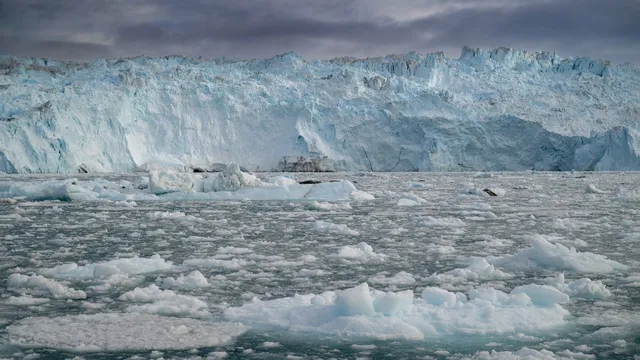
In recent years, researchers have focused on the impact of Greenland's rapidly melting ice sheet on the Atlantic Meridional Overturning Circulation (AMOC), a crucial system that regulates global climate. A new study indicates that the runoff from this melting ice could lead to a significant weakening of the AMOC, potentially causing up to 40% of its decline by the year 2300 if current climate trends continue. This research highlights the importance of integrating Greenland's ice sheet into climate models, as previous studies have often overlooked its influence compared to Arctic meltwater.
The AMOC is responsible for transporting warm water from the tropics to the Northern Hemisphere and returning cold water back toward Antarctica. It has been observed to be at its weakest in over a millennium, primarily due to the effects of Arctic ice melt and rising ocean temperatures. The implications of a weakened AMOC are severe, including the potential for freezing weather in Northwest Europe, increased sea-level rise along the U.S. East Coast, and droughts in equatorial regions. The study suggests that while the AMOC is weakening, it may not collapse irreversibly as previously feared.
Using the EC-Earth3 global climate model, researchers found that the AMOC could recover if greenhouse gas emissions were reduced or if the meltwater influence was removed. This finding indicates that the AMOC may be more stable than earlier models suggested, which often predicted a sudden and irreversible collapse. The study's lead researcher, von Hardenberg, emphasized the need for more comprehensive models that include the Greenland ice sheet to better predict future scenarios and understand the extent of AMOC weakening.
Experts in the field have acknowledged the significance of this research, noting that integrating the Greenland ice sheet into climate models will enhance the accuracy of AMOC predictions. While the study's findings are promising, further investigation is necessary to confirm the results across different models and scenarios. The ongoing research into the effects of Greenland's ice melt on the AMOC is crucial for understanding the broader implications of climate change and for developing effective strategies to mitigate its impacts.