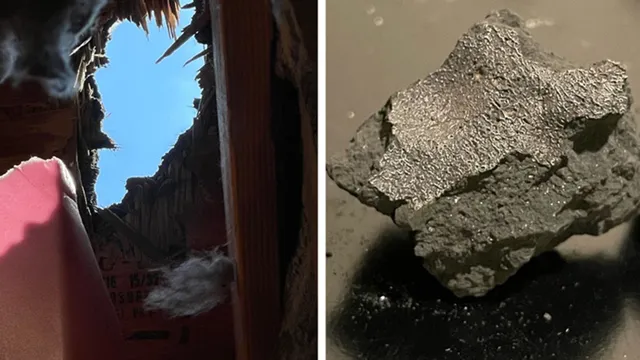
In July 2024, a meteorite crashed through a home in Hillsborough, New Jersey, providing a unique opportunity for scientific study. The homeowner reported hearing a loud crash and discovering a hole in the ceiling of his master bedroom, along with fragments of the meteorite and a strong sulfur-like odor. The meteorite, later named Hillsborough, was found to contain amino acids and other prebiotic molecules, which are essential building blocks of life. This discovery has significant implications for understanding the origins of life on Earth and the potential for life elsewhere in the universe.
The meteorite was observed by at least 60 people across New York, New Jersey, and other Northeastern states, traveling at an impressive speed of 32,000 mph. The meteor broke apart in midair, and fragments were tracked by Doppler weather radar after it reached an altitude of 22 miles. The American Meteor Society played a crucial role in tracing the meteor's path back to the asteroid belt, confirming that the Hillsborough meteorite is a carbonaceous chondrite, a type of stony meteorite known for its rich organic content.
The study, led by Peter Jenniskens from the SETI Institute and NASA's Ames Research Center, highlighted the importance of the homeowner's quick actions in preserving the meteorite fragments. By using disposable gloves and aluminum foil to collect the pieces, he ensured that valuable scientific data could be obtained from the meteorite. The forensic analysis revealed that the fragments contained preserved bits from a primitive asteroid that had experienced concentrated salty fluids, a process not previously documented in this type of protoplanet.
The findings from the Hillsborough meteorite contribute to the ongoing research into the building blocks of life and the conditions that may have existed on early Earth. The presence of amino acids and other organic compounds in the meteorite suggests that similar materials could be found on other celestial bodies, raising questions about the potential for life beyond our planet. This event not only underscores the significance of meteorite studies but also emphasizes the need for continued exploration of our solar system to uncover the mysteries of life's origins.