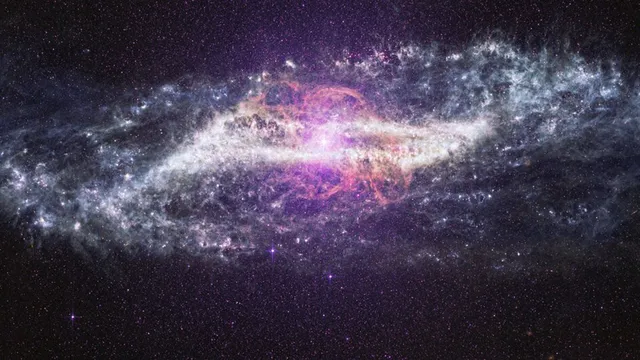
In a groundbreaking observation, the James Webb Space Telescope (JWST) has provided an unprecedented view of Centaurus A, a galaxy located relatively close to Earth. This galaxy, known for its unusual and active nature, has been shaped by a significant cosmic collision that occurred approximately 2 billion years ago. The JWST's ability to detect infrared wavelengths allowed it to penetrate the thick dust that obscures the galaxy's center, revealing intricate details of its structure and the aftermath of its violent history. The telescope's Mid-Infrared Instrument captured the galaxy glowing in white and pale pink, showcasing filaments, loops, and clouds of warm dust that illustrate the turbulent events that have shaped Centaurus A over time.
The image highlights the scars left by the ancient merger with another galaxy, which has influenced the arrangement of dust and gas within Centaurus A. The warped structures and colorful ribbons visible in the image are evidence of the galaxy's dynamic evolution, demonstrating how such mergers can trigger star formation and impact the growth of galaxies. The presence of a supermassive black hole at the center of Centaurus A plays a crucial role in this process, as it both fuels and limits star formation. As material falls toward the black hole, it releases immense energy and generates powerful jets that further shape the surrounding environment.
The JWST's observations come as part of its fourth year of scientific operations, which began with the release of stunning images in July 2022. Launched on December 25, 2021, the telescope is expected to operate for about 20 years, providing astronomers with valuable insights into the universe. The detailed images of Centaurus A not only enhance our understanding of this particular galaxy but also contribute to the broader knowledge of galaxy formation and evolution in the cosmos. The findings underscore the importance of advanced observational technology in uncovering the hidden aspects of the universe, revealing the complex interplay between galaxies, black holes, and the materials that compose them.
As scientists continue to analyze the data collected by the JWST, the implications of these observations will likely lead to new discoveries and a deeper understanding of the processes that govern the universe. The ability to visualize the intricate details of galaxies like Centaurus A marks a significant advancement in astronomical research, paving the way for future explorations of the cosmos and the mysteries it holds.