James Webb telescope reveals ancient galaxies through gravitational lensing
science
ground breaking breakthrough
innovative

James Webb telescope reveals ancient galaxies through gravitational lensing

12
(Update: )
administrator of NASA in 1961–1968
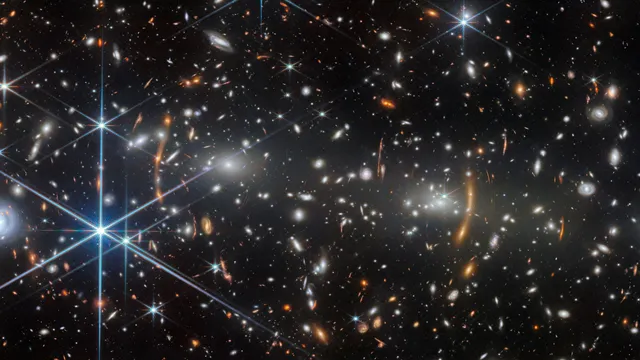
  • The James Webb Space Telescope has captured images of a galaxy cluster known as MACS J0553.4-3342, located in the constellation Columba.
  • This observation utilizes gravitational lensing to reveal faint galaxies from less than a billion years after the Big Bang.
  • The findings challenge existing cosmological theories regarding the growth of the oldest stars and galaxies.
Share opinion
1

Story

In a groundbreaking observation, the James Webb Space Telescope (JWST) has utilized the phenomenon of gravitational lensing to explore galaxies that formed in the early universe, specifically from less than a billion years after the Big Bang. This observation took place in the constellation Columba, where the telescope focused on a massive galaxy cluster known as MACS J0553.4-3342. The cluster consists of two massive elliptical galaxies that are in the process of merging, providing a unique opportunity for astronomers to study the light emitted from these ancient galaxies. Gravitational lensing, a concept first predicted by Albert Einstein nearly a century ago, occurs when massive celestial objects bend the fabric of space-time, allowing light from distant sources to be magnified and warped. This effect has been confirmed through numerous observations and is now a vital tool for astronomers. The JWST's recent image showcases this effect, revealing several faint galaxies that would otherwise remain undetectable. The light from these galaxies, which dates back approximately 4.4 billion years, offers insights into the early stages of galaxy formation and evolution. The two principal galaxies in the MACS J0553.4-3342 cluster are currently about 1 million light-years apart, having previously collided. As they continue to merge, they will eventually form a single, larger galaxy. The JWST's observations have uncovered that the oldest stars and galaxies in the universe appear to have grown larger and faster than current cosmological theories predict. This unexpected finding challenges existing models of galaxy formation and suggests that our understanding of the universe's early history may need to be revised. The implications of these discoveries are significant, as they not only enhance our knowledge of the universe's evolution but also demonstrate the capabilities of the JWST in probing the farthest reaches of space. The gravitational lensing effect observed in this image allows astronomers to peer into a time when the universe was still in its infancy, providing a glimpse into the conditions that led to the formation of galaxies. As research continues, the JWST is expected to remain a crucial tool for astronomers, potentially leading to new discoveries that could reshape our understanding of the cosmos.

Context

The study of early galaxy formation has profound implications for our understanding of the universe's evolution. By investigating the formation and development of galaxies in the early universe, researchers can gain insights into the conditions that prevailed shortly after the Big Bang. This research helps to elucidate the processes that led to the formation of the first stars and galaxies, which are critical for understanding the cosmic timeline. The implications extend beyond mere historical curiosity; they touch on fundamental questions about the nature of dark matter, the role of supermassive black holes, and the mechanisms of galaxy evolution over cosmic time. One of the key findings from early galaxy formation studies is the realization that galaxies formed much earlier than previously thought. Observations from advanced telescopes, such as the Hubble Space Telescope and the James Webb Space Telescope, have revealed galaxies that existed just a few hundred million years after the Big Bang. This challenges existing models of galaxy formation and suggests that the processes involved were more efficient than previously believed. Understanding these early galaxies can provide clues about the initial conditions of the universe and the subsequent formation of larger structures. Moreover, the study of early galaxies has significant implications for our understanding of dark matter. The distribution and behavior of dark matter are crucial for galaxy formation, and early galaxy studies can help refine models of dark matter's role in the universe. By analyzing the mass and structure of these ancient galaxies, researchers can infer the properties of dark matter and its influence on galaxy formation. This research is vital for developing a comprehensive model of the universe that incorporates both visible and dark matter components. In conclusion, the implications of early galaxy formation studies are vast and multifaceted. They not only enhance our understanding of the universe's history but also challenge existing theories and models. As technology advances and new observational tools become available, the field of galaxy formation will continue to evolve, potentially leading to groundbreaking discoveries that reshape our understanding of the cosmos.