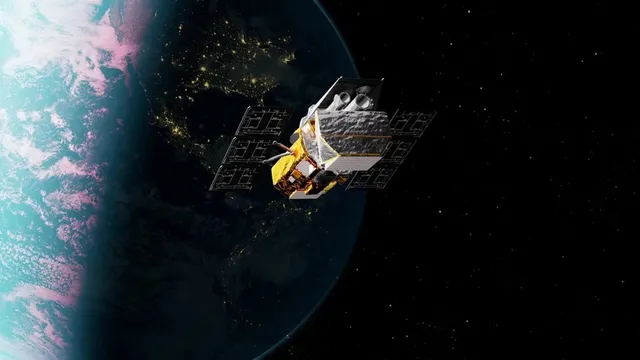
In the United States, a commercial spacecraft named LINK, designed to rescue NASA's Swift Observatory, has encountered significant operational issues shortly after its launch in early July 2026. The spacecraft, developed by Katalyst Space Technologies for $30 million, was intended to boost the decaying orbit of the Swift Observatory, which is located approximately 350 kilometers above Earth. Swift has been a highly productive scientific asset for NASA, but its observations have already been paused due to its deteriorating condition. Without timely intervention, there is a risk that the observatory could re-enter the atmosphere and be destroyed later this year.
The LINK spacecraft was equipped with three robotic arms to capture the Swift Observatory and utilize xenon-gas thrusters to elevate its orbit. However, just days ago, LINK began spinning uncontrollably and lost communication with ground control. Two of its three onboard reaction wheels, which are crucial for maintaining the spacecraft's orientation, have failed, and some of the smaller thrusters that assist with fine guidance have also lost functionality. This malfunction poses a serious threat to the mission, as both systems are essential for a safe rendezvous with Swift, which was not designed for capture by another spacecraft.
NASA reported that the issues began over the weekend, after LINK had successfully completed several preliminary milestones, including deploying its solar arrays and test-firing its thrusters. Katalyst Space Technologies has stated that initial corrective maneuvers were successful, but the stabilization process is expected to take several days. The company remains optimistic about the mission, asserting that it is still active and that they plan to adjust LINK's software to compensate for the failed hardware.
The LINK mission is significant not only for its immediate goal of rescuing the Swift Observatory but also as a test of whether robotic spacecraft can service satellites that were not originally designed for in-orbit repairs. This capability could potentially extend the operational life of expensive space missions in the future. Historically, NASA's space shuttles performed servicing missions with astronauts, but LINK represents a shift towards fully robotic operations in space. As the mission progresses, the success or failure of LINK could have lasting implications for the future of satellite servicing and the longevity of space observatories.