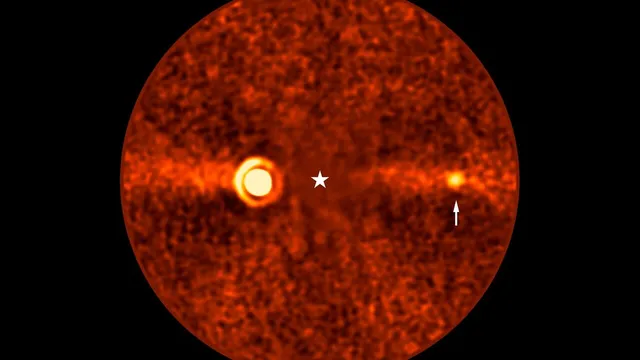
In December 2025, researchers at the University of Edinburgh, led by postdoctoral research associate Sutlieff, were conducting observations of the Beta Pictoris star system using the Very Large Telescope in Chile. Their primary goal was to study the atmosphere of the known planet B Pictoris b. However, during their analysis, Sutlieff noticed a faint speck in the data that appeared to be a new planet. This speck was located in a disk of dust around the star, which is believed to be remnants from the planet formation process.
To confirm the existence of this potential planet, Sutlieff collaborated with astronomer Markus Bonse from the European Southern Observatory. Bonse applied machine learning algorithms to enhance the image, and the speck remained visible, suggesting it was indeed a planet rather than a background star. They then examined older archival images from the Very Large Telescope and the James Webb Space Telescope, which provided further evidence of the planet's existence, detectable by the residual heat from its formation approximately 20 million years ago.
The newly identified exoplanet, named B Pictoris d, is a gas giant with a mass about 2.4 times that of Jupiter. It orbits its star in a wide, 91-year-long orbit. While it is large compared to planets in our solar system, it is relatively small compared to the other known planets in the Beta Pictoris system, which are around ten times the mass of Jupiter. This discovery highlights the ongoing efforts in the search for exoplanets, as astronomers believe there are likely trillions of planets in the Milky Way yet to be discovered.
The advancements in technology, such as the upcoming Extremely Large Telescope set to begin operations in 2029, are expected to significantly enhance the search for new exoplanets. The findings from Sutlieff and Bonse's research serve as a reminder of the potential for new discoveries in the field of astronomy, as they likened their search to a decade-long game of hide-and-seek. The study was published in The Astrophysical Journal Letters, contributing to the growing body of knowledge about exoplanets and their atmospheres.