Physicists create black hole from light to explore Hawking radiation
science
ground breaking breakthrough
innovative

Physicists create black hole from light to explore Hawking radiation

10
(Update: )
British theoretical physicist, cosmologist and author (1942–2018)
  • Physicists created a miniature black hole using light in a laboratory setting.
  • They observed Hawking radiation for the first time, confirming Stephen Hawking's predictions.
  • This breakthrough could lead to a better understanding of black holes and quantum mechanics.
Share opinion
1

Story

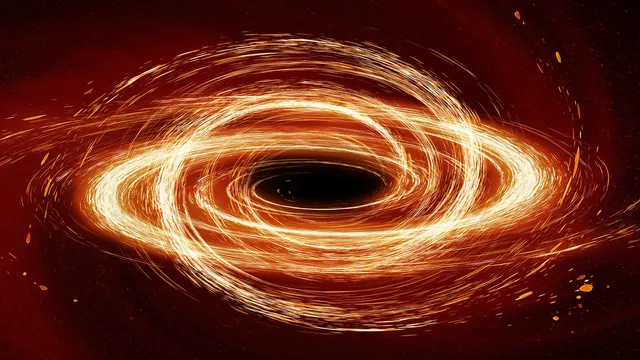
In a groundbreaking experiment conducted in a laboratory, physicists successfully created a miniature black hole using light, marking a significant advancement in the study of black hole physics. This experiment allowed researchers to observe Hawking radiation, a phenomenon predicted by Stephen Hawking, which describes the faint thermal emission that should escape from black holes. The team utilized a strand of optical fiber to simulate the conditions necessary for the formation of a black hole's event horizon, where space moves faster than light. By manipulating light within the fiber, they were able to generate pairs of particles, one of which escaped as ultraviolet light, providing a tangible glimpse into the elusive Hawking radiation. The experiment's design hinged on the concept of a moving medium, which in this case was the light itself. As the light pulse traveled through the optical fiber, it altered the way the glass bent light, creating a dynamic environment that mimicked the conditions around a black hole. This innovative approach not only demonstrated the generation of Hawking radiation but also offered insights into the mechanics behind its creation. The researchers counted photons in the ultraviolet spectrum that corresponded to the theoretical partners of Hawking radiation, thus validating their experimental setup. One of the critical challenges in black hole physics is the trans-Planckian problem, which arises when attempting to trace the origins of Hawking radiation back to the Planck scale, a realm where conventional physics breaks down. The researchers believe their findings may provide a clearer understanding of this issue, suggesting that Hawking radiation can indeed be produced from phenomena occurring at scales smaller than those currently understood in physics. This breakthrough could pave the way for future experiments that delve deeper into the quantum aspects of black holes and their radiation. Looking ahead, the research team plans to explore quantum effects related to their findings, aiming to further unravel the mysteries surrounding black holes and Hawking radiation. This work not only enhances our understanding of fundamental physics but also opens new avenues for research in quantum mechanics and cosmology, potentially leading to revolutionary discoveries in the field.

Context

Hawking radiation is a theoretical prediction made by physicist Stephen Hawking in 1974, which describes the process by which black holes can emit radiation and ultimately lose mass. This phenomenon arises from the principles of quantum mechanics and general relativity, suggesting that black holes are not entirely black but can emit particles due to quantum effects near their event horizons. According to quantum theory, pairs of virtual particles are constantly being created and annihilated in empty space. Near the event horizon of a black hole, one of these particles can fall into the black hole while the other escapes, leading to the emission of radiation. This escaping particle is what we refer to as Hawking radiation. The implications of Hawking radiation are profound, as it suggests that black holes can evaporate over time. The rate of this radiation emission is inversely proportional to the mass of the black hole; smaller black holes emit radiation at a higher rate than larger ones. Consequently, a sufficiently small black hole could evaporate completely in a relatively short time, while a supermassive black hole could take billions of years to lose a significant amount of mass. This process challenges the traditional view of black holes as eternal objects, introducing the concept of black hole thermodynamics and the relationship between entropy and information. Hawking's work has sparked significant interest and debate within the scientific community, particularly regarding the information paradox. This paradox arises from the question of what happens to the information contained within matter that falls into a black hole. If black holes can evaporate completely, it raises the issue of whether the information is lost forever or if it can be recovered in some form. This dilemma has led to various theories and ongoing research in the fields of quantum gravity and theoretical physics, as scientists seek to reconcile the principles of quantum mechanics with the nature of black holes. In summary, Hawking radiation represents a groundbreaking intersection of quantum mechanics and general relativity, providing insights into the nature of black holes and the fundamental laws of the universe. While it remains a theoretical concept, the implications of Hawking radiation continue to influence our understanding of black holes, thermodynamics, and the nature of information in the cosmos. As research progresses, it may lead to new discoveries that could reshape our understanding of the universe and the fundamental forces that govern it.