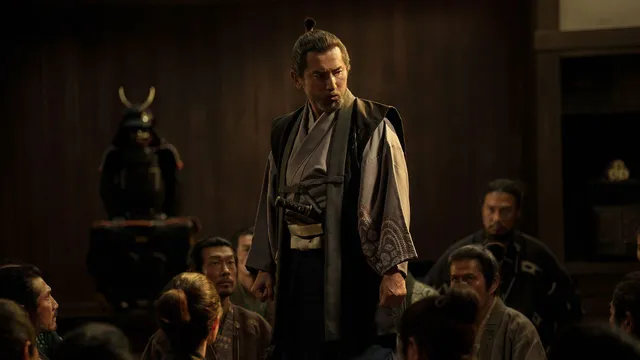
Kiyoshi Kurosawa explores faith and war in new historical drama
military conflicts
controversial
tragic

Kiyoshi Kurosawa explores faith and war in new historical drama

11
(Update: )
Japanese accounting academic
American film critic
  • The film depicts a siege in Japan led by Nobunaga Oda, focusing on the conflict between warlord Murashige Araki and envoy Kanbei Kuroda.
  • The narrative unfolds over four acts, each representing a season, and features a series of mysterious deaths that complicate the plot.
  • Kurosawa's adaptation explores themes of faith, leadership, and the moral implications of war, ultimately reflecting on the human experience amidst conflict.
Share opinion
1

Story

In Japan, a historical drama unfolds against the backdrop of a siege led by the ruthless conqueror Nobunaga Oda. The film centers on Murashige Araki, a warlord who defies Oda, and Kanbei Kuroda, an envoy sent to persuade him to surrender. As the castle is surrounded, the tension escalates, revealing a complex narrative filled with puzzling crimes and moral dilemmas. The story is structured into four acts, each representing a season, and introduces a series of mysterious deaths that complicate the already dire situation. The film's narrative is rich with dialogue and explores themes of faith, leadership, and the consequences of war. The adaptation from Honobu Yonezawa's novel presents a unique blend of historical context and detective fiction elements. As the siege progresses, the characters grapple with their beliefs and the harsh realities of their circumstances. The film's pacing allows for a deep exploration of the characters' motivations and the moral implications of their actions. The narrative's complexity is heightened by the presence of multiple murderers, creating a sense of intrigue and suspense. The film ultimately reflects on the significance of seemingly minor events within the larger context of conflict, emphasizing the human experience amidst chaos. Kurosawa's film stands out for its serene filmmaking style, contrasting the grim events depicted. The characters' interactions reveal their inner struggles and the weight of their decisions, making the audience question the nature of honor and duty in times of war. The film's exploration of faith and the human condition resonates deeply, inviting viewers to reflect on the broader implications of violence and resistance. As the story unfolds, it becomes clear that the siege is not just a physical battle but also a moral and philosophical one, challenging the characters' beliefs and convictions. In conclusion, the film serves as a poignant reminder of the complexities of war and the human spirit's resilience. It invites viewers to consider the cost of conflict and the importance of understanding the past to shape a better future. Through its intricate storytelling and character development, the film leaves a lasting impact, encouraging discussions about the nature of power, faith, and the choices we make in the face of adversity.

Context

Nobunaga Oda, a prominent figure in Japanese history, played a crucial role in the unification of Japan during the late 16th century. Born in 1534, he emerged as a powerful daimyo, or feudal lord, in the Owari Province. His innovative military strategies, including the use of firearms, and his ability to forge alliances with other clans were instrumental in his rise to power. Nobunaga's ambition was not only to consolidate his own power but also to bring an end to the Sengoku period, a time characterized by social upheaval and constant military conflict among rival clans. His vision for a unified Japan laid the groundwork for the eventual establishment of the Tokugawa shogunate, which would dominate Japanese politics for over 250 years. One of Nobunaga's most significant achievements was the decisive victory at the Battle of Okehazama in 1560, where he defeated a much larger army led by Imagawa Yoshimoto. This battle showcased his tactical brilliance and solidified his reputation as a formidable military leader. Following this victory, Nobunaga continued to expand his territory, capturing key locations such as Kyoto in 1568. His control over the capital allowed him to influence the imperial court and further legitimize his rule. Nobunaga's policies promoted trade and commerce, leading to economic growth in the regions under his control. He also supported the spread of Christianity, which introduced new ideas and technologies to Japan, further modernizing the country. Nobunaga's reign was marked by his ruthless approach to governance. He was known for his brutal tactics against rival clans and his willingness to eliminate anyone who posed a threat to his power. This included the destruction of the Enryaku-ji temple, a significant Buddhist institution, which he viewed as a challenge to his authority. While his methods were often harsh, they were effective in consolidating power and reducing the influence of the warrior monks who had previously held significant sway in Japanese politics. Nobunaga's legacy is complex; he is both revered for his contributions to the unification of Japan and criticized for his violent methods. Tragically, Nobunaga's life was cut short in 1582 when he was betrayed by one of his generals, Akechi Mitsuhide, leading to his forced suicide at Honnō-ji temple. Despite his untimely death, Nobunaga's impact on Japanese history is undeniable. His efforts to unify Japan set the stage for his successors, particularly Toyotomi Hideyoshi and Tokugawa Ieyasu, who would continue his work and ultimately achieve the unification he envisioned. Nobunaga Oda is remembered as a pivotal figure in the transition from feudal warfare to a more centralized and stable government in Japan, making him a key historical figure whose influence is still felt today.