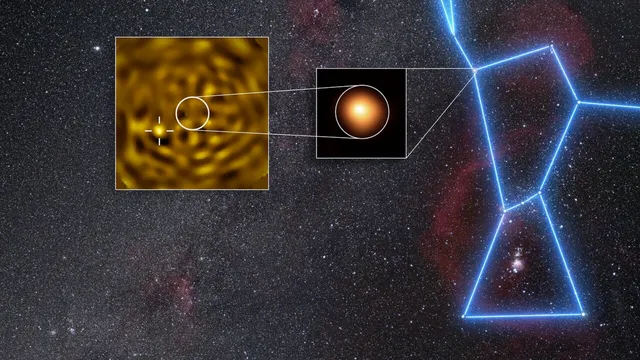
In July 2026, astronomers from the European Southern Observatory announced a significant discovery regarding Betelgeuse, a prominent red supergiant star located in the constellation Orion. This discovery was made possible through the use of the Very Large Telescope, which allowed researchers to capture the clearest images of a faint companion star orbiting closely around Betelgeuse. The findings were detailed in a paper published in the journal Astronomy & Astrophysics, marking a pivotal moment in the study of this well-known celestial body.
For decades, Betelgeuse has been a subject of fascination for both amateur and professional astronomers due to its unique characteristics, including its pulsating brightness that follows a 400-day cycle. However, scientists have long been puzzled by an additional dimming and brightening pattern that occurs approximately every six years. Two independent research teams, one led by Morgan MacLeod from Harvard University and the other by Jared Goldberg from the City University of New York, investigated this anomaly. Their analyses suggested that the unusual brightness fluctuations could be attributed to a hidden companion star orbiting Betelgeuse.
In December 2024, astronomers anticipated that the companion star would move far enough away from Betelgeuse to be observable. Following this prediction, a team led by Miguel Montargès from the Paris Observatory focused their observations on Betelgeuse using the European Southern Observatory's telescope. After months of data analysis, they successfully identified what appears to be this companion star, now referred to as Betelgeuse B. This discovery is particularly remarkable as it challenges previous assumptions about the mass of the companion star, which was initially thought to be similar to that of the Sun but is now believed to be two to three times more massive.
The implications of this discovery are significant, as it raises questions about the potential impact of the companion star on Betelgeuse's evolution. As a red supergiant, Betelgeuse is nearing the end of its life cycle and is expected to eventually explode in a supernova. Understanding the dynamics between Betelgeuse and its companion could provide insights into the processes that govern the life cycles of massive stars. Montargès emphasized the importance of confirming the presence of the companion star with further observations, stating that while there is little doubt about its existence, additional data is necessary to solidify this finding. This discovery not only enhances our understanding of Betelgeuse but also contributes to the broader field of stellar evolution and the complexities of binary star systems.