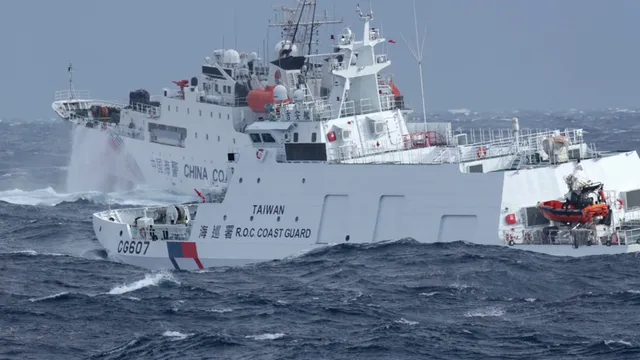
China escalates maritime patrols to tighten grip on Taiwan
military conflicts
impactful
controversial

China escalates maritime patrols to tighten grip on Taiwan

11
(Update: )
country in East Asia
  • China has conducted multiple maritime patrols east of Taiwan, marking a new phase in its enforcement operations.
  • These actions are a response to Japan and the Philippines' discussions on maritime boundaries, which China claims infringe on its sovereignty.
  • Analysts warn that these patrols could lead to a blockade of Taiwan, highlighting the island's vulnerability.
Share opinion
1

Story

In recent weeks, China has intensified its maritime patrols in the waters east of Taiwan, marking a significant shift in its enforcement operations. The Maritime Safety Administration and coastguard have conducted multiple 'special maritime law enforcement operations' as part of this strategy. Analysts suggest that these actions could be a precursor to a blockade of Taiwan, as they represent a new level of assertiveness in the region. The patrols are reportedly a response to discussions between Japan and the Philippines regarding their maritime boundaries, which China claims infringe upon its territorial sovereignty. China's government has framed these operations as legitimate actions to safeguard its territorial rights and maintain order at sea. The country views Taiwan as a province and asserts that its exclusive economic zone (EEZ) falls under its jurisdiction. This perspective is further complicated by China's claims over large areas of the South China Sea and East China Sea, which are contested by several neighboring countries, including Japan and the Philippines. The situation has raised concerns among security analysts, who warn that the increased law enforcement activities could escalate into more aggressive military actions. The strategic implications of these patrols are significant, particularly for Taiwan, which relies heavily on imports for its energy needs. Experts have described China's approach as a 'boa constrictor strategy,' gradually tightening its grip on Taiwan through various pressure tactics, including military exercises and cyberattacks. The recent patrols are seen as part of a broader campaign to isolate Taiwan and assert China's dominance in the region. The potential for these operations to evolve into a blockade or quarantine has been highlighted by analysts, who emphasize Taiwan's vulnerability as an island nation. The geopolitical landscape in the Indo-Pacific region has shifted dramatically, with the United States' focus on other global issues, such as the Middle East, leaving a perceived gap in its response to China's maritime expansion. While the U.S. does not officially recognize Taiwan as a separate country, it has committed to supporting the island's defense. However, recent statements from U.S. officials have raised questions about the reliability of these commitments, particularly in light of changing dynamics in the region. As tensions continue to rise, the international community watches closely to see how this situation will unfold and what it means for regional stability.

Context

The impact of China's maritime operations on Taiwan is a multifaceted issue that encompasses military, economic, and geopolitical dimensions. Over the past few years, China has significantly increased its naval presence in the Taiwan Strait and surrounding waters, conducting military exercises and patrols that have raised concerns in Taipei and among its allies. These operations are often perceived as a show of force aimed at intimidating Taiwan and asserting China's claim over the island. The frequency and scale of these maneuvers have escalated tensions in the region, prompting Taiwan to enhance its own defense capabilities and seek closer ties with the United States and other regional partners. The strategic importance of the Taiwan Strait, a vital shipping lane for global trade, further complicates the situation, as any conflict could have far-reaching economic consequences beyond the immediate region. Economically, Taiwan is heavily reliant on maritime trade, with a significant portion of its exports passing through the Taiwan Strait. China's maritime operations pose a direct threat to this trade, as increased military activity could disrupt shipping routes and lead to heightened insurance costs for vessels operating in the area. Additionally, the potential for conflict could deter foreign investment in Taiwan, as businesses may seek to avoid the risks associated with instability. The Taiwanese government has been proactive in addressing these challenges by diversifying its trade partnerships and investing in domestic industries to reduce reliance on any single market. However, the looming threat of China's maritime assertiveness continues to cast a shadow over Taiwan's economic prospects. Geopolitically, China's maritime operations are part of a broader strategy to assert its influence in the Asia-Pacific region. The South China Sea and the Taiwan Strait are critical areas for China's ambitions, as they are not only vital for trade but also for military positioning. The United States has responded to China's actions by reaffirming its commitment to Taiwan's defense and conducting freedom of navigation operations in the region. This has led to a complex interplay of power dynamics, with Taiwan caught in the middle of a larger contest between the U.S. and China. The situation is further complicated by the involvement of other regional players, such as Japan and Australia, who are also concerned about China's growing assertiveness and its implications for regional security. In conclusion, the impact of China's maritime operations on Taiwan is profound and multifaceted, affecting military, economic, and geopolitical aspects of the island's existence. As tensions continue to rise, Taiwan must navigate a delicate balance between enhancing its defense capabilities, maintaining economic stability, and fostering international partnerships. The future of Taiwan in the face of China's maritime assertiveness will depend on its ability to adapt to these challenges while seeking to preserve its sovereignty and security in an increasingly complex regional landscape.